Showing posts with label WWII. Show all posts

27 October 2018

malta: malta: mosta and mdina and rabat

Since the island of Malta is relatively small and has good transport to get all over, I decided to sleep in Valletta for three or four nights and do a couple day trips to see sights in other places.
Malta has a lot of history in war, despite being quite small. The most recent war in which fighting happened on the island was WW2. The geographic importance of the island was huge, it was actually under seige for over two years.
I wanted to see a part of that particular history, so I hopped on a bus to the small town of Mosta, which of course has a giant church. The ride was not long, and the bus stop is obvious, right next to the church. Despite being huge, it is 'just' a parrish church.
The name of the church is the Basilica of the Assumption of our Lady, but not one calls it by that name. It is more commonly known as the Mosta Dome or Rotunda of Mosta, because that is the part of the church through which history happened.
The chuch goes back to the early 17th century, though that building was much smaller. In the 19th century a new church was built, right around the old church. Wikipedia tells me local citizens helped out with some of the building, on Sundays and holidays.
The dome is huge, it was the third largest in Europe at one point. The interior diameter is 37 meters, not too shabby. The walls holding it up are 30 feet thick! Even though the church is circular, there are side chapels all around the circle.
On 9 April 1942 the Luftwaffe dropped three bombs in the area in the evening. One of them went straight through the rotunda, while a gathering of 300 people was celebrating an evening service inside the church. The bomb didn't explode, it just sat in the middle of the floor. Needless to say, this was considered a miracle.
Engineers from the Royal Bomb Disposal unit defused the bomb and dumped the remains in the sea off the island, and a replica is now inside the church. The story behind the bomb is the reason anyone comes to Mosta, because the town is otherwise unremarkable.
There is an entry fee to this church, sigh. It isn't much, but it's still annoying. It doesn't take long to walk through the church, appreciating what happened, as well as appreciating the artistry of the building itself.
After seeing the church I walked into one of several nearby bakeries to pick up snacks. No, I didn't need the piece of cake, but I have no regrets :)
I went back to the same bus stop to catch my next bus, out to the walled city of Mdina. This bus stop was also right next to where I wanted to go, yippee!
Mdina is an ancient walled city, it was actually the capital of the island from antiquity to the Middle Ages. The walls are still standing, and the whole thing is still really photogenic. 
Continued reading in Wikipedia tells me the current population is around 43.
Like many cities from way back in the day, the streets in Mdina are not straight, and they are narrow. The greatest part of exploring Mdina is getting lost in the many small alleys. You start walking into one of them and you're never sure where you'll end up.
There were of course several churches. One of the churches I passed had locked gates in front, but the doors behind the gates were open. In other words I was able to peek inside, but was not able to go in. 
Another church was part of a monastery, it was actually a chapel with a beautiful ceiling. There was another huge church with an entry fee, I was getting tired of the fees by this point. That being said, the fee on this one included entry in the next door museum, which was quite nice.
After getting completely turned around in the alleys a number of times, I felt like I'd seen most of Mdina, so I walked back out of the main gate, (there is a moat around the city, I wonder what it looked like back in its heyday,) and to the modern city next door, called Rabat.
Even though Rabat is thought of as the 'new' city, it was part of the core of the original medieval city before Mdina was split off, and has plenty of visible history. I found more churches, and well known catacombs. The biggest church in Rabat was free, thank goodness.
Rabat isn't nearly as pretty as Mdina, but there are more than 11,000 people living there. It definitely feels more alive than Mdina. (to be honest, Mdina feels more like an Instagram location now, not so much a real city. There are heaps of people in the really photogenic spots - doors with floral decorations, etc - but no markets anything real.)
After finishing exploring I walked down the main road until I found a bus stop in the shade. I'm not usually such a fan of shade when sun is an option, but the past couple days in the direct sun had gotten to me.
I had to wait a while, but eventually a bus came along and brought me back to Valletta.

03 May 2018

russia: volgograd


As I said in an earlier post, when Bo planned his visit he planned to come during a time when he would be able to see Moscow, as well as travel to several other Russian cities. I had my May holiday break, so we chose to hop on a train and head south.
We decided to start our trip by visiting Volgograd, which has a centuries long history. It was known as Tsaritsyn from 1589-1925, then known as Stalingrad from 1925-1961. The name was changed to Volgograd in 1961. I've heard and read that some people want to change the name back to Stalingrad, but I have no idea if that will happen.
We left on a Thursday evening, the train to Volgograd was loooong. Very very looong. 21 hours long. Bo and I shared a kupe with 2 Russian men, they were keen to share their buffet and alcohol with Bo. (They offered the vodka to me as well, but I had to say no because of my allergy to alcohol.) It was quite funny for me to watch, and very traditional behaviour.
Surprisingly, this train was late in arriving in Volgograd, 25 minutes late!! When you think about it, that's not a lot of time considering how long the train ride was, but for the Russian train system, that's unacceptable. 
When we arrived we discovered the main train station in the city was partly under renovation, which meant there was dust everywhere, and piles of construction materials. Not fun. Plus I wasn't able to take a nice photo of the front of the station.
The late arrival was hard for me because the landlord of the apartment I had booked called me, asking where I was. Since we had arrived late, and it was a new (to me,) city, I had no idea where we were, I just knew we were making our way to the flat. To get there we used the city tram system, and some walking. 
I'm a sucker for public transport.
We finally got to the flat and checked in, then rested for a bit. I'm not sure why we rested, given that we'd just spent nearly a full day sitting/sleeping on a train. When we went out we found a supermarket to get food, since we had a kitchen to use for a couple nights.
The next morning we made a tentative plan for the day, then started walking. A travel app I use had a few sights listed within walking distance, we aimed for those. Only a couple of them were where the map said they would be, a couple large war memorials.
We learned very quickly that Volgograd is a city FULL of memorials. The city was basically blown to smithereens during WW2, everything was flattened. If I understand correctly, more than a million people died in the battle of Stalingrad, some numbers go up to nearly 1.8 million. It was one of the biggest battles of the entire war, and lasted almost 6 months.
To make a lot of wandering around a shorter story, we ended up walking all the way to Mamaev Kurgan, a hill in the city. On the hill is the giant war memorial complex people recognize from around the world. 
The big statue (called The Motherland Calls,) is 53 meters tall, 83 meters tall if you go all the way to the tip of the sword. She sits on a hill, one of the highest points of the city. When she was built in 1967 she was the largest free standing sculpture in the world; as of 2016 she is the tallest statue of a woman in the world.
There are a number of specific war memorials on the way up the hill, all of them big as well.
There is a reflection pool as well, though it wasn't very clean while we were there; the water was a bit green. 
There were vendors selling magnets and ice cream, I wish they'd been just outside the whole memorial area, not right in the middle.
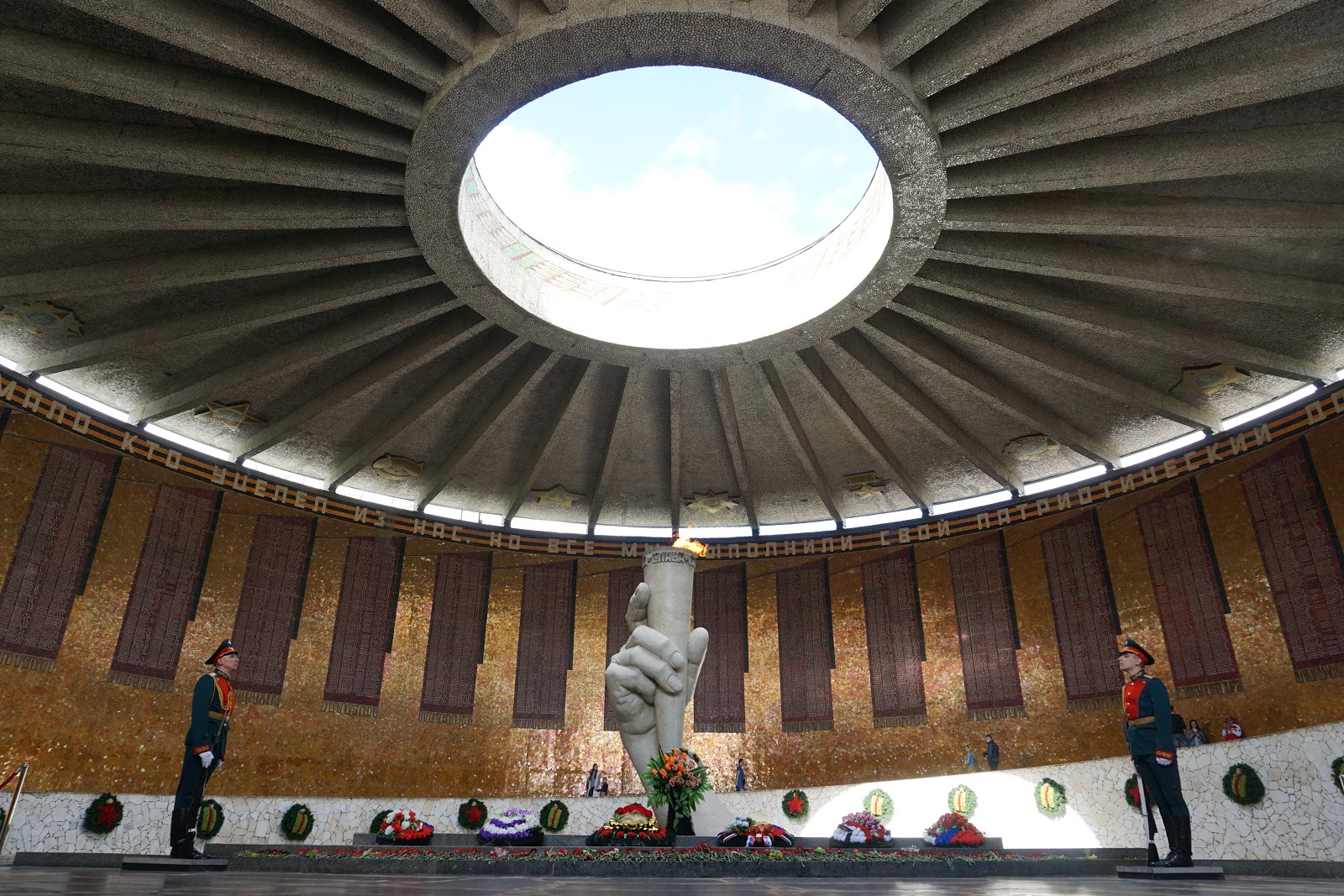
Under Mamaev Kurgan is a memorial hall. It doesn't stand out as much as the other memorials, but when you step inside the building you're probably going to say 'whoa,' under your breath. It is a large circular room, with an eternal flame in the middle. Two soldiers stand guard near the flame, and there are wreaths and flowers there as well.
Around the edge of the room is a walkway that slants up so you walk out on the second level. On the walls of the room are names of some of those who lost their lives during the battle. It's really really impressive.
There is a chapel on the hill as well, though it isn't nearly as impressive as some Orthodox chapels/churches I've seen. The main focus of this hill is honouring and memorializing the war, and those who were involved.
We left the area by walking down the hill. We kept walking, ending up at the train station.
During the day we'd talked about where we would go during this trip, and thought we had a good plan. Talking to the people at the train station and checking options online made it clear that our plan wasn't going to happen. We ended up leaving the train station without buying tickets, and going to the bus station instead. We bought tickets for the next morning, going to a smaller town.
After getting that sorted, we realized we were hungry, and chose doner sandwiches. Yum.
Just before sunset we arrived at a big statue of Lenin. He is a commanding presence (as always,) with a half circle of large columns behind him.
A couple blocks behind Lenin was our last sight for the day, the ruins of a mill. If I remember correctly, it is the last remaining building standing as it was at the end of the war. Anything else that looked like this mill (not much, the whole city was flattened,) was destroyed and built again.
Right next to the old mill (you don't get to go inside,) is another war museum. We didn't visit, but did appreciate the circular architecture.
The next day we went to Elista, read about that in a different post.
We arrived back in Volgograd from Elista late afternoon two days later. We checked into a hotel, relaxed for a bit, then went for a walk. The purpose of the walk was mostly to find dinner, and see the train station when it was lit up at night.
The city of Volgograd is mostly spread out along the banks of the Volga River, the first days in the city we'd mostly seen one half of the city. This time we decided to walk in the other direction along the river.
We found the front of a theatre, and a smaller statue of Lenin. We found a second theatre with a fountain in front, I liked it better. We also found a university with medallions of Lenin on top of the front facade of the building. Near a major intersection we found a statue that didn't have anything to do with war. (A rarity in this city.) It was dedicated to the founders of the city, back in the 16th century.
We kept going, finally coming to another large memorial. This one was dedicated to the sailors of Severomorsk. (I don't know who or what that is.)
It's a big statue, which wouldn't be much of a difference in this (or any Russian) city; the difference is because there are huge words spelled out on top of the building behind the statue. It is really impressive.
At that point we felt as if we'd gone far enough in that direction, so we walked back toward the city center. After a supermarket stop for snacks, we found the Alley of Heroes. It was a large pedestrian area, which blocks of stone dedicated to specific groups. The alley sits at the top of a big set of steps, which lead down to the riverbank.
At one level of the steps is a set of gates that I think are supposed to represent gates to the city. If we had been able to see it from the middle of the river, or from the other side, I'm guessing the view would be quite impressive.
In a platz near the alley, at the top of the steps were letters spelling out the name of the city. I love these signs. Bo pretended the first two letters were just for his name ;)
We found dinner nearby, then went back to the hotel to pick up our bags. It didn't take us long to walk to the train station, where we boarded rather quickly and departed on time. Yay for the Russian train system.
I liked Volgograd, and I think there are other cities in the area that I'd be happy to visit. In other words, I might return to this part of Russia.

14 March 2009

thailand 2

after our short beach time, we decided to head up north...as much as we love beaches, we know we'll have plenty of opportunities to see them...and really, does it matter how beautiful it is when i'm laying out, eyes closed? don't get me wrong, i love them, but i do the same thing on each one..hee hee...
we arrived in the town of kanchanaburi next...most of you probably don't know that name, or care for that matter...but you've probably heard of the movie "bridge over the river kwai"...right? i've heard of it, even though i've never seen it...apparently i should watch it...anywho, the bridge is in kanchanaburi...kanchanaburi is a town with a fair amount of WWII historical stuff to see...the bridge of course, which is where we started...just walking over it the first day...the bridge is part of 415km (i think) of track the japanese used forced labour to build during 1942-43...in normal circumstances, that length should have taken 5 yrs to build...the japanese (and their korean guards,) made their workers get it done in 16-17 months...the way they treated the prisoners/volunteers was awful...they broke the treaties which they had said they would abide by, the hague convention, i think? (it was signed and ratified back in the early 1900s i think)...(on a side note, they signed but did not ratify the geneva conventions)...they didn't feed the prisoners enough, they didn't provide proper shelter or clothes, and the work being done was definitely helping the japanese militarily...(the track was laid in order to give the japanese another supply line to help with their planned invasion of india)...at one point, they had workers working 16 hour shifts, round the clock...around 200,000 people worked on the line...90,000 "volunteers" died...these were locals, and natives of thailand, lao, cambodia, etc who had been recruited or voluntold to work for the japanese...16,000 allied POWs died...not only were they not taken care of well, but the equipment with which they built the line was practically non existent...cutting through solid rock with just hammers, drills, and some dynamite!! one of the days in kanchanaburi i took a bus out to what's known as hellfire pass...so called because of the way the fires looked at night when they were working round the clock...there is a very tasteful museum, and you can walk through hellfire pass itself...the track isn't there anymore...there isn't much in the museum in terms of items, simply because there wasn't much leftover after the war was over...the interpretive boards had a lot of information, but it wasn't overwhelming...i also road the train back to kanchanaburi, and that included riding over the famous bridge...others on the train included a group of russians, who were all busy drinking, or taking pictures...THE ENTIRE TIME!!
kanchanaburi also has a couple allied war cemetaries...they're taken care of really really well...they're quiet places, people don't talk much...one of them is slightly out of town, you have to hire a bike to get there...it's a lot smaller, but the gravestones look the same as in the cemetary in town...there was very little talking by anyone in either cemetary...no matter what side of that war you were/are on, there is a lot of emotion..
in kanchanaburi we stayed on the river...and i mean ON the river, not next to it, on the banks...our bungalow was made of bamboo, and sat out on the water...everytime a boat went by we could feel the bungalow rock in the waves...totally awesome...so quiet and peaceful...except for the karaoke boats of course...they started up each evening, just ask dusk was coming...as everyone knows, some people are good at karaoke...some are, well, not...
layna loved kanchanaburi, and wasn't interested in the next town i wanted to visit, so she decided to stay there an extra couple days, and i moved on...my next destination was ayuthaya...for whateva reason, there are several different spellings in english...i guess it depends on who is producing the postcards...(postcards in ayuthaya were expensive, for whateva reason)...ayuthaya is at the point where three rivers come together, which was supposed to create a natural barrier as well as encourage trade...at it's height, there were over a million people living in ayuthaya...ayuthaya was a capital city for over 400 years, during which time 33 kings reigned...and apparently there was a rule that you had to build several temples while you were king, because the temples (well, their ruins anywho) are EVERYWHERE in ayuthaya...EVERYWHERE...obviously, some are in better shape than others...on two days i hired a bike and spent 6 hours each day pedaling around town, investigating the ruins...ayuthaya is completely flat, so a cruiser bike is absolutely perfect...at one set of ruins two monks even asked to take a picture with me...i was thrilled, of course...i had wanted just such a picture, but since i'm female, didn't think that was okay...women aren't even supposed to directly hand something to monks...so i put my camera on the ground, and the one taking the picture picked it up...go figure, i look awful in the picture...but i didn't feel like i could turn around and say hey, can we do that again...hee hee...i was also interviewed by thai uni students (who said they were majoring in english, buuuuuuuuut i don't know about that) as to why i was in thailand, what i like about the country, where i'm going, etc...ayutthaya is quiet at night, for the most part...except for the karaoke at one of the bars not too far from my guesthouse...i was there three nights, and heard it each night, and it sounded like the same guy...so maybe that was his job? i seriously hope he had another job as well...some of his attempts weren't awful, but some....hmmm...well, i couldn't always tell what song it was he was trying to sing...