Showing posts with label kremlin. Show all posts

05 July 2020

russia: moscow oblast: mozhaisk


Mozhaisk is another random town I visited in Moscow Oblast, not long after it became permissable for me to do so. I was just happy to be able to see a new place, and wore a mask the entire time I was on the train. It is not listed in my Russia guidebook, so I must've heard about it through social media.

Mozhaisk is about 110 kilometers west of Moscow, with a population of just over 30,000. The documented history goes back to 1231, when it was part of the Chernihiv region. (This region is part of what is now Ukraine.) Later it was part of the Smolensk region, followed by the Moscow region. At some point in history, Mozhaisk was also part of Lithuania, showing how big that empire was at various points. 

What I get from reading this history is that the location was important, but the city itself was never strong enough to be independent.

In 1812 the Battle of Borodino took place not far from Mozhaisk, just 12 kilometers away. I hadn't realized how close the two towns are until I saw a few signs in Mozhaisk pointing in the direction of Borodino. I'm guessing some people come to both of them on one day on a tour.

During WW2 the Wehrmacht took control of Mozhaisk in October 1941, the Red Army took it back in 1942.

Mozhaisk is now a relatively small town. It isn't well known, and definitely isn't on the 'must see' list for anyone visiting Russia. That being said, its a cute town, with history worth seeing.

It is easy to get to Mozhaisk, all I had to do was take an elektrichka, which took two hours. The train station isn't in a particularly convenient location, but it was still walkable distance, at least in my head.

I started by walking toward the stela that marks Mozhaisk as a city of military glory. It looked just like the majority of such monuments I've seen. 

There was nice landscaping around the monument, and as I looked over to buildings nearby, I saw huge murals showing war scenes on the sides of the buildings. Mozhaisk clearly knows its own history as a location where lots of fighting has taken place.

I took photos and kept going. Next up was the first of two Lenins I wanted to see. The first was a full size statue on a pedestal, painted silver. He stood in front of a government building of some sort. Nothing special, but I always want to see Lenin statues.

My second intended sight was also a Lenen, though this one was just a large profile of his head, on the side of a grocery store. (It always surprises me where I find Lenin.) The walk to get to the profile took a while, (as it was basically on the other side of town,) but the weather was nice, and it gave me some great views over the surrounding area.

After seeing the Lenin profile, I walked back toward the city center, heading in the general direction of the main sight in town, the kremlin. For reasons I don't know, the kremlin in Mozhaisk is called the Detinets, but I'll probably refer to it as the kremlin throughout this entire post.

One of the views on the way to and from the Lenin profile was of the kremlin, which sits on the edge of a small hill. Absolutely lovely. If there had been trails to walk around the hill, I would've been happy to walk all the trails. 

The kremlin itself is several centuries newer than the town, though still plenty old. The first cathedral in the kremlin was made of stone, and built in the early 14th century. As I got close to the kremlin, I realized it was still very photogenic, but also really small. Standing at the entrance gate I could see the entire territory, I think it was just two churches, and a model of what the kremlin used to look like.

As I was there during the height of summer, the flowers were in full bloom, the grass was green, etc... The sky was blue, so every photo I took was full of colour. At least from the outside. The inside of the churches wasn't nearly as eye catching. It didn't take me long to visit the churches and wander over the entire territory, it really is a small area.

From there I went back to the main street in town and followed it north. This part of my visit took me past a WW2 monument, which had the usual combination of a wreath, an eternal flame, plaques with names, and dates. I took a few minutes to honour those who gave everything for their country (whether they wanted to or not,) then kept walking.

A little bit later I saw a sign telling me to turn left to get to a monastery. This monastery is the second main sight of Mozhaisk. An official tour of the city probably includes the kremlin and the monastery, then moves out of the city.

Luzhetsky Monastery is the short name for a relatively small place. The full name is Nativity of the Theotokos and St.Therapont Luzhetsky Monastery. I wonder if anyone ever calls it the full name, because its certainly a mouthful. I didn't even try saying the name in Russian, not even in my head. 

Luzhetsky Monastery was founded in 1408, by a man named Therapont Belozersk. He created the monastery based on the commands of Prince Andrey of Mozhaisk, who never let him leave. Belozersk died in the monastery in 1426; he was later canonized by the Russian Orthodox Church.

Luzhetsky monastery is surrounded by white walls with a few towers. The main cathedral, which was built and rebuilt several times, has five domes, and sits in the middle of the territory.

As I got closer and closer to the walls and entry gate, dark clouds started rolling through the sky, really really fast. Since there are a couple open fields near the monastery, the view of those clouds over the monastery was quite striking. This kind of a sky is my second favourite. (My favourite is a blue sky, with a few white clouds; yes, I'm very basic at times.)

There was no fee to enter the monastery, and since the main church is the only thing open to see, it didn't take me long to visit. Like about half the churches in Russia, the outside of the church was more eye catching (probably because of the crazy clouds,) than the interior. (The other half are the other way around. It seems rare that a church looks amazing both inside and outside.)

Not too far from this monastery was a house museum, that of artist S.V. Gerasimov. I ended up on a mini tour of the museum, which was not my intention. The docent clearly wanted to practice her English, and she seemed nice, so I let it happen. 

The museum was mostly paintings of Gerasimov, though there were also displays of the work of his family members and his students. All in all it was nice.

My last attempt at a sight was another church. Unfortunately, the entrance gates to the territory of this church weren't open, darnit. Oh well.

By that point it had started to rain. Thank goodness the rain wasn't too heavy, but it made the walk allllll the way back to the train station really humid and rather unpleasant. Because of the rain I wanted to take public transport, but when I looked at my options, it was only going to be five minutes faster, and was still going to cover half the distance with walking, so I opted to walk the entire way.

My arrival at the train station were nearly perfectly timed, I only had to wait 20 minutes for the next train back to Moscow. Yay!

I doubt I'll return to Mozhaisk, I think I saw everything on the list of sights.

08 January 2020

russia: vologda


Vologda was the last place I visited during the second part of my New Year's holidays. It is listed in my guidebook, and is conveniently located a night train's distance from St Petersburg. Wikipedia tells me the 2010 census shows more than 300,000 people live in Vologda.
Surprise surprise, Vologda is another Russian city with multiple founding dates in the city history. The oldest date is 1147, which would make the city as old as Moscow. This date comes from a guy in 1780 who was writing a book called 'Stories and Miracles of Gerasimus of Vologda.' 
According to this book that is when the Trinity Monastery was founded, so official city documents use that date as when the city was founded.
Even though this is the official city date, Wikipedia goes on to tell me that this is the wrong date. There is no scientific evidence to back up a founding year of 1147. Scientific evidence does back up a founding date in the 13th century; the city was mentioned as a possession of the Novgorod Republic in 1264.
When Ivan IV (usually known as Ivan the Terrible,) was in power Vologda became a center of trade, via the White Sea. 
At the time, most of the trade with foreign countries was with England, Holland, and other western countries. In 1566 Ivan traveled to Vologda to supervise the founding of a new fortress, on the Vologda River.
One of the churches inside this new fortress was Saint Sophia Cathedral, which was the first stone building in the city. Until then, everything had been made of wood. In 1571, before construction was finished, Ivan left the city, and never returned. 
Legend says he wanted the church demolished, as he had received a head injury when a small rock had fallen on his head, and therefore he considered the whole thing unlucky.  The church wasn't demolished, but wasn't consecrated until after he died.
In 1612 Lithuania took control of the city, and burned it down. Not long after, the city was able to rebuild itself pretty quickly, and use its location as a center of trade as an advantage to bring in money. Vologda continued as a center of trade for a while, and when Peter the Great became tsar he made the city host to a main military base.
Vologda lost much of its trade importance after St Petersburg was founded in the 18th century. The city began to decline, but when Catherine the Great became empress it started to grow again. When railways connected the city to Moscow, St Petersburg, Yaroslavl, etc..., businesses and trade started to grow.
Though Vologda is not considered to be part of Siberia, it was also a center of exile. Wikipedia tells me famous people like Stalin and Molotov were sent to Vologda for a time.
Near the end of WW1 Vologda became the 'diplomatic capital' of Russia, when some countries were worried about the safety of their embassies in St Petersburg and moved them temporarily to Vologda. This lasted only a few months, until the Bolsheviks kicked everyone out of Vologda and the whole country if I understand correctly.
WW2 wasn't good to Vologda, as it became one of many fronts after the Finnish military crossed the border. Residents dug trenches, built bomb proof shelters, and industrial organizations switched to military production.
After the fall of the Soviet Union, it took Vologda a few years to sort itself out. The political change happened in 1991, but the first elections in Vologda didn't take place until 1994. That being said, the city has sorted itself out, and is now the capital of the oblast.
I arrived in Vologda before sunrise, so I sat in the train station for a little while, staying warm and figuring out what I wanted to see/do during the day. As soon as I left the station I saw a city sign, so I made my first photo of the city straightaway.
From there I walked all the way to the accomodation I'd booked. 
I found the address easily enough, but figuring out how to get in was a different matter. There were two doorbells, and I rang them both several times, but no one answered the door. I called the number on the booking, which turned out to be a family member of the guy managing the place, then they called the guy, then he opened the door.
I got settled in, then relaxed for a couple more hours. Eventually I went back out, and headed toward my first sight, the kremlin. The kremlin is the fortress I mentioned above, built in the mid 16th century. It is still the main sight in the city, and based on the crowd, is popular with locals, not just tourists. When I got to the platz just outside the kremlin I found holiday decorations, as well as a holiday fest taking place, complete with music, games, and food.
I went into the kremlin area, noticing that one of the churches was closed for renovation. (This probably means I'll never see the church, as these sorts of renovations tend to take years.) 
I was cold and tired, and as it was Christmas Eve (6 January,) I didn't see much open. The area inside the walls was actually pretty small, but I think there are normally several museums in there.
After leaving the kremlin, I walked toward the first of three Lenin statues in the city. This one was the biggest Lenin.
Not only were there three Lenins, they were all pretty close to each other. At this point the weather was super windy almost nonstop, with clouds rolling through really fast. 
In the sun, it felt great, when the clouds came, not so much. I got to Lenin number two just a few minutes later, this one had his name spelled out, which I've found is not terribly common.
Lenin number two was on one side of Revolution Square. On another side of the square was the 0km mark, showing the spot in Vologda from which distances are measured. I like these kinds of monuments.
In the platz itself was a war memorial, with an eternal flame.
Lenin number two also wasn't far from the Church of John the Baptist, which is where I went next. It was warm inside, the interior was quite small. 
The iconostasis wasn't exciting, but I liked the carpets spread around the floor.
When I walked out of the church I headed toward one of the bridges over the river. Along the way I walked through a small park with another war memorial in the middle, this one had names and the dates of the war.
Next to one side of the bridge was a quirky monument. A dog lifting his leg next to a pole is supposed to memorialize the first lamp post. Kinda cute, kinda not. 
At this point the light was starting to change to the blue light that comes before sunset. Even though I hadn't been out and about for very long, I decided to get dinner.
Vologda doesn't have a huge number of restaurants, so I settled on pizza. After pizza I found a branch of a coffee shop I'd visited in Nizhny Novgorod, I remembered it as having really good chocolate cheesecake. Needless to say, I was more than happy to have it again.
When I'd left the hostel earlier in the day, the manager showed me which doorbell to use when I came home in the evening. 
I used that doorbell, but it didn't make any sound. I called him directly, and said I was home, and he came out to open the door. I told him neither doorbell worked, but I don't think he understood me. Argh.
The next morning I packed up and checked out, then walked back to the train station to drop my bag for the day. It was a long-ish way to go, but I didn't want to have to deal with the lack of working doorbells and leave my pack in the hostel all day.
From the train station I had another long walk, all the way to a big monastery. The walk from the train station to Spaso-Prilutsky monastery was over eight kilometers, and took me a couple hours at least. I don't walk all that slowly, but I do stop regularly for photos, and on this day I had to walk through snow a few times.
A few mini snowstorms as well. The kind where everything is lovely, then ten minutes of not seeing where I'm going, then back to clear-ish.
Not far from the monastery I saw a double train bridge, which was just neat to see. 
I assume trains going one way went on one bridge, then trains coming the other way go on the other bridge, but I don't know. I like bridges, it was neat to see two of them so close to each other.
Spaso-Prilutsky Monastery looks like someone played with different sets of Legos to put it together. A couple of the exterior walls are red brick, two others are white. The various towers around the whole thing are of different styles too. Nothing matches. Weird.
The monastery was first established in 1371. Like most religious facilities, the Soviet period was not good for the monastery. It was abolished in 1924, and the buildings were used for private residences, a prison, a depot, and a museum. Thankfully, all the buildings were preserved, just not used as they were originally intended. The monastery reopened in 1991, and still functions as it was meant to.
I wandered through the areas I was able to see, there weren't many. I also walked along the tops of the walls, which were open for this. I love walking on monastery and fortress walls.
Even though the walk to the monastery took a while, in then end I was there for just 30-45 minutes. The walk back wasn't quite as long, since I only walked to the city center. After getting back to the city center I went to see Lenin number three, and made a photo with him. He stood in front of the main university in the city.
After visiting with Lenin, I felt as if I'd seen what I wanted to see in Vologda. I went back to the coffee shop from the day before, eating a full meal before having another piece of chocolate cheesecake. 
I was in a seat near a plug, so I took the chance to charge my phone for a couple hours before walking back to the train station.
I guess I was in a cheapskate mood when I booked my ticket back to Moscow, as I booked a seat, not a bunk. Trying to sleep while sitting up is hard enough, it was even harder because the lights came on every couple hours when there were bigger stops. Argh. I was knackered when I finally got back to Moscow.
I would go back to Vologda, though I'd prefer to do it in warmer weather. Since this visit, I've looked at the city map, and found a few more things to see :)

30 December 2019

russia: tobolsk


Tobolsk was the last city I visited during my winter mini tour of Siberia. (And I've already decided that I'd like to see all the cities again in summer, or at least warmer weather, just to see how they look different.) Tobolsk is in the Tymen oblast, and has nearly 100,000 residents.
Wikipedia tells me Tobolsk is one of the traditional capital cities of Siberia, though I'm not sure what exactly that means. The city was first founded in 1590 by a group of Cossacks. It was the second city founded in the region, not long after Tyumen.
In 1708 Tobolsk received its first school, theatre, and newspaper; all of these were the first in Siberia. After the Battle of Poltava (now in Ukraine,) in 1709 some members of the losing Swedish Army were sent to Tobolsk as prisoners. There were so many of these prisoners that they made up 25% of the city population, some of them ended up staying for good, even after repatriation was possible.
Tobolsk became the residence of more prisoners after the Decembrist revolt in 1825. Some of these exiles also ended up staying in Tobolsk permanently.
Tobolsk lost some regional power when the main route of the Transsiberian railway built between Tyumen and Omsk didn't pass through Tobolsk. You can arrive in Tobolsk by train, but the train station is not at all close to the city itself, not even my crazy definition of walking distance would consider the distance between the train station and Tobolsk as walkable.
After the February revolution in 1917, the tsarist empire of Russia ended. The reigning tsar abdicated, and with his family went into exile in Tobolsk for a few months. (From Tobolsk they went to Yekaterinburg in 1918, where they were brutally murdered in July of that year.)
Wikipedia tells me the economy of modern Tobolsk centers on a major oil refinery and the petrochemical industry. Some traditional crafts, such as bone carving are also preserved. Tourism is also part of the economy, because of its historical importance, architecture, and natural landscapes.
I arrived in Tobolsk, and wanted to walk to town, only to realize that it really wasn't walking distance. That in addition to this being Siberia and it being winter made walking a no go. Even waiting for the bus in front of the train station was quite cold.
When I booked my hostel in Tobolsk, I decided to book a cell in what used to be a wing of the prison in the kremlin area. The address listed on the booking wasn't quite the actual location, but when I found the actual location I discovered that check in was in a completely different hotel, in a completely different location/building. Since I was cold and tired, I was annoyed by all this.
Several of the cells in the prison had been converted into hostel dorms, I think I was the only person in the whole thing during the night I slept there. 
Another of the former cells had been made into the kitchen, though it had only a kettle and a table. No real cooking facilities. Yet another former cell was the bathroom and toilet.
After resting up for entirely too long, I went out to walk. The prison I was sleeping in was in the wall surrounding a church and museum. I thought about trying to go in them, but discovered the entry fees and just wasn't in the mood for paying entry fees. Sometimes I'm happy to do this, sometimes not so much.
Not too far away from the prison gates was the main platz in the old city center. This is the part of Tobolsk that is in the middle of the old kremlin walls. I assume it is normally a rather empty area, but at this time of year it was filled with ice sculptures and a giant Christmas tree. I had fun looking at the different sculptures and loved that there weren't too many other people around. There were a couple ice slides, making me regret (yet again,) that I didn't have something to slide on. 
I really should've bought something in Kurgan or Chelyabinsk when I saw things available.
One side of the festival had giant bears, just like the ones I'd seen in Tyumen. I guess Siberian bears are a major stereotype of the region, and Russia in general, sooooo....
Also in the area is the Assumption Cathedral, which was the main church in the old kremlin area. I think part of it is under renovation, but I was still able to go inside, and I loved the interior. Lots of brightly coloured frescoes, a gold iconostasis, tall columns. 
The interior area wasn't very big, but there weren't too many other people around, so it didn't feel crowded.
After wandering all over this area, I decided to wander up one of the bigger streets in town and just see where it went. By this point it was already dusk, with total darkness coming fast. Obviously I'd wasted too much of the day relaxing in my hostel, oh well. What can I do to change this habit of mine, as I've lost way too many hours when I should've been exploring. 
While walking I saw the main WW2 memorial, complete with eternal flame. Due to the lack of sunlight, I decided to wait until the next day to take photos. I also decided to wait in taking photos of two giant murals on the sides of buildings. More photo waiting happened when I walked past some painted snow sculptures.
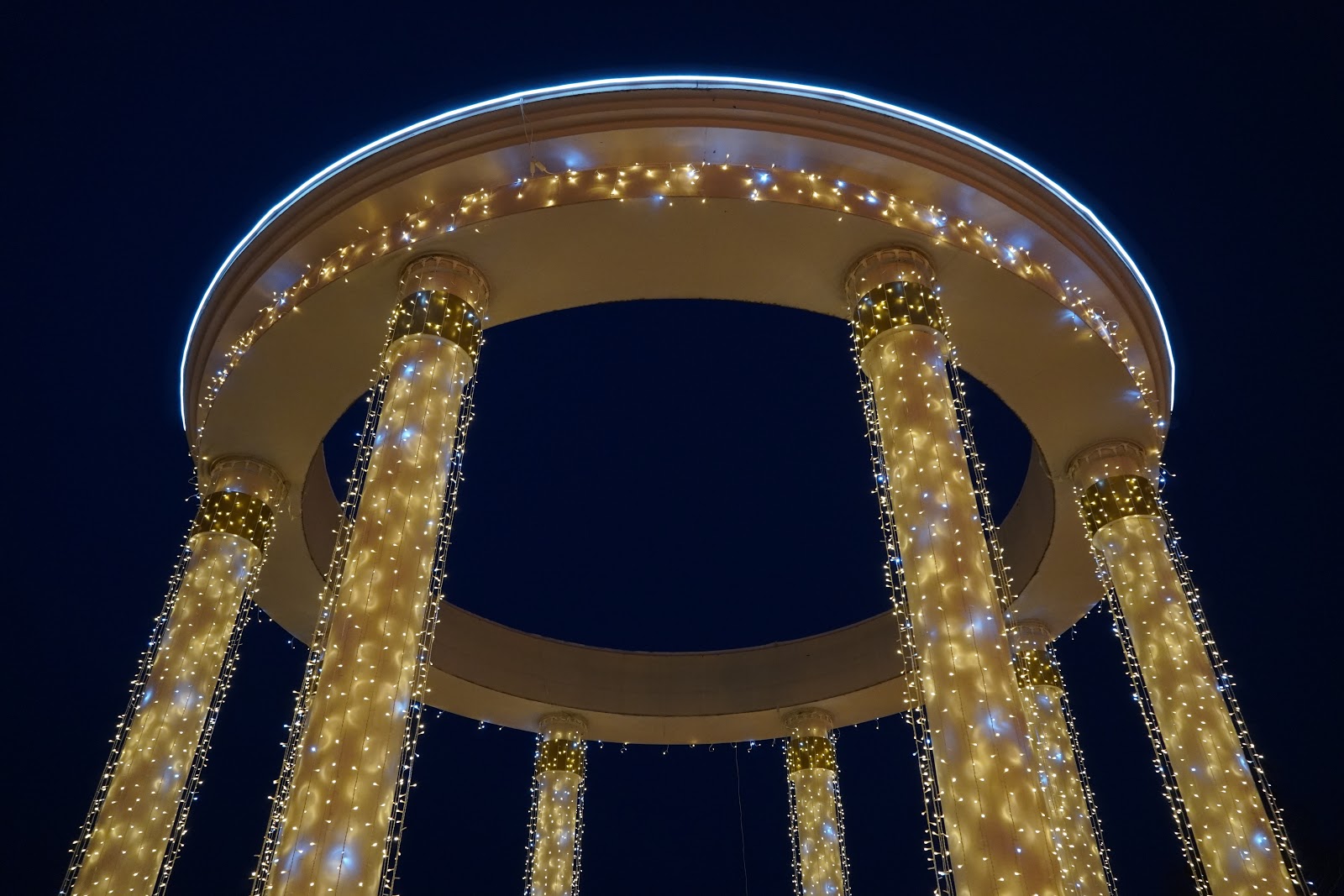
I walked all the way to the end of a cemetery, marked with a gazebo. The gazebo was covered in holiday lights, which were absolutely lovely in an otherwise dark area. I normally like to explore cemeteries, but I wasn't about to do that in the dark and cold. 
After taking photos in the gazebo I turned around and walked back to my hostel, with a stop at a supermarket along the way.
Getting back into my prison was more of an adventure than I wanted it to be. When I'd checked in, the lady told me that the main gate closed at 1800, effectively closing the museum and church to visitors. She gave me a code to open the gate if I needed to go through after hours. When she did this, the gate was open, so I assumed the code system would be easy to work.
It wasn't. I tried the code over and over again, but the gate didn't budge. I admit I got really frustrated, and started crying. I was cold, tired, and not able to get into my accomodation, argh. Fortunately, a guard inside the gate heard me trying over and over, and came out to see what was happening. He showed me how to open the gate with the code, and it included lifting up on one section, which I'm pretty sure the earlier lady hadn't mentioned. Phew. I wonder how long the security guards stick around after closing hours?
I slept like a rock. Even with the long sleep, and the knowledge that daylight was short, it still took me a while to get going the next morning. I packed up and checked out, leaving my pack at the luggage area of the hotel that had handled my check in.
I started my sightseeing on a gorgeous day (still quite cold, but a blue sky instead of dark gray,) with a walk around the old kremlin walls. The view at one end was out over part of the city, it was a lovely view.
My next sight was a memorial at one end of a park area. I'll admit I didn't pay attention at the time to the sign telling me what was being memorialized. Later on I looked it up, Google reviews told me the memorial is dedicated to the Ermak victories of the 16th century.
I walked up Oktober street, past a monument to Dostoyevsky to Peter and Paul Church. It was small, but I don't skip many churches if I can go in. The inside wasn't very interesting, but the lady inside decided I needed to learn a bit about the church, so she gave me a few dates, as well as showing me the baptismal bath.
After leaving the church I went back to the main street I'd walked the day before, so I could take the mural photos and the war memorial photos and the snow sculpture photos. They were all way better in daylight, as expected.
Last night I walked to the gazebo, then turned around. This day I kept going, by walking around the traffic circle. Not much further along I found a small bakery which had tasty treats and a warm interior. I stayed in there for at least an hour, warming up my phone, my camera, and the batteries for both.
Not long after I left the bakery I noticed some runners coming up the pavement on the other side of the street. Not only were they running outside in -16C weather, they were in fancy dress (costume.) The ladies were wearing Snegurechka costumes, she is the granddaughter of Ded Moroz. The men were wearing Ded Moroz costumes.
After seeing the runners, I remembered that while riding the bus into town I'd seen a random building with unique architecture. I'd marked it on the map and decided to go back later. 
This seemed like a good time to do that, so I kept walking. A while later I got to the building, it was actually a government building! A state committee for something, I don't think there is an equivalent in the States, so the name didn't mean anything to me.
At this point it was sunset, which was a completely different experience with a non cloudy sky. Absolutely beautiful, and really quiet, if that makes sense.
I walked into every supermarket I passed on my way back to the hotel to pick up my pack, at least three of them. I can't help it, I'm always looking for yogurt or other snacks.
I picked up my pack, then found the bus stop to catch the bus back to the train station. There was a schedule posted, but it wasn't accurate, argh. I ended up having to wait more than thirty minutes for the bus I needed, but at least I had the time to wait. When I got to the train station I had a few more hours to kill, then boarded my train as soon as it pulled in.
Finding a place to put my pack in my area was a challenge, as one of the other passengers had a fake Christmas tree as his luggage. The tree took up the entire area above the beds, annoying me. He offered me the space below his bunk, which is the normal thing to do, but I was nervous because I was going to get off the train at 0230, and I knew he'd have to stand up at that hour for me to get my pack. Thankfully, he understood when I told him this, and it ended up being no problem at all.
I'd like to see Tobolsk again, in warmer weather.