Showing posts with label science city. Show all posts

02 February 2020

russia: obninsk


One of the many things I love about living in Moscow is that there are a zillion places nearby that are easy to visit for a day trip. I learned about one of them, a city called Obninsk, on social media. The city is 100 kilometers southwest of Moscow, with a current estimated population of 115,000.
Obninsk is a new city, founded only in the 20th century. A research institute was built, then a nuclear power plant. The city was built to support the power plant. With the building of the city there was housing for the scientists, teachers, engineers, and workers coming to the area.
Obninsk is an official science city, it was actually the first science city, receiving the designation in 2000. Most of the decoration around the city is scientific, like depictions of spinning atoms. Wikipedia tells me the city is home to twelve science institutions. The main areas of interest are nuclear power engineering, nuclear radiation technology, meteorology, and ecology and environmental protection.
Fun fact: one of the sister cities of Obninsk is Oak Ridge, Tennessee, USA. Oak Ridge is also a city with nuclear power. (And a pretty good club swim team.)
I looked up transportation to the city, my first option was at 0700 on a Saturday. That seemed really early for a weekend, so I opted for the next train, which departed at 0852. That was still before I normally start work during the week, but seemed a lot more reasonable. As always, the train arrived on time, at 1042. (Have I ever mentioned how fantastic the Russian train system is, especially in regards to departing and arriving on time, no matter the weather?)
The train station in Obninsk was not interesting, not at all. Nothing like a grand train station I always want to see when traveling in Russia. 
It was basically a set of two identical buildings, on either sides of the tracks. Each building had ticket machines, turnstyles, and a few benches, nothing else.
I arrived to a flat white sky. In terms of taking photos, this is basically the worst, but it isn't as if I could do anything about it. There was snow and slush everywhere, but it did not snow while I was there.
My first sight was a city stelae. It was nice to see, but I wasn't able to get close, as it was in the middle of a platz between two large apartment buildings. 
The platz was completely covered in snow, and surrounded by a fence, preventing me from getting close. Booo. That ended up being the only city sign type thing I saw all day. The stelae had the name of the city, as well as several scientific symbols, like the image of a spinning atom.
Next up was a science monument, this one to the pioneers of nuclear engineering. I liked it, even more so because I could take a couple stairs and be on the monument. The monument sits at the meeting point of two streets, in a triangle shaped platz.
I kept going up the street, to another monument. This one was a submarine, or at least the conning tower (is that the right name?) of a submarine. The monument itself is dedicated to the 50th anniversary of the first nuclear submarine fleet. (I think.) It isn't a real submarine, you can't go inside anything.
More walking brought me to yet another scientific monument, this one to Igor Kurchatov. He was a nuclear physicist, most known for being the director of the Soviet atomic bomb project. (The Soviets didn't figure out how it all works until after WW2 was over.)
The monument was on a property surrounded by another fence. The first two gates I passed were closed, I didn't think I'd be getting close to this monument either, until I passed the last gate, which was open.
I continued down that street, passing some of the most boring apartment buildings I've seen. I'd describe the architecture style as Soviet brutalist. Concrete everywhere, with some patterning, also in concrete.
Next up was the Church of the Nativity. The best part of it was the colour, which was yellow.
Given the gray sky, and gray apartment buildings I'd seen, yellow seemed pretty darn gorgeous; on a day with better weather, the church would've been far less eye catching. The iconostasis inside was pretty, but there was no frescoe painting on the walls or ceiling.
Across the street from the church was a school of music, which had an interesting entryway, but the building itself was another example of 'boring.'
I kept going, eventually getting to the number one listed sight in Obninsk, a former estate of wealthy/noble families. Usad'ba Belkino isn't much to see anymore, it is just an abandoned building, totally falling apart. 
It is surrounded by a fence, so you can't climb in the ruins. (Maybe safety has actually been thought of in this country, once!) Despite the fence, you can stand close enough to see through the windows and holes to see where some interior painting remains. Lets just say that the interior decoration style of this house is not something I ever want to have in my own home.
This abandoned manor is in a corner of a park. The park is probably a great place to hang out in in summer, it is nice even in winter. I saw quite a few families on sleds and innertubes, sliding down small hills. 
There was also a small bridge of locks and a gazebo. Pretty, but not important in any noteworthy way.
It was a bit of a longer walk to my next sight: a cute statue. This one was called the Intelligent Cat. It sits right next to a big piece of granite. If I understand correctly, rubbing the rock brings good luck to students.
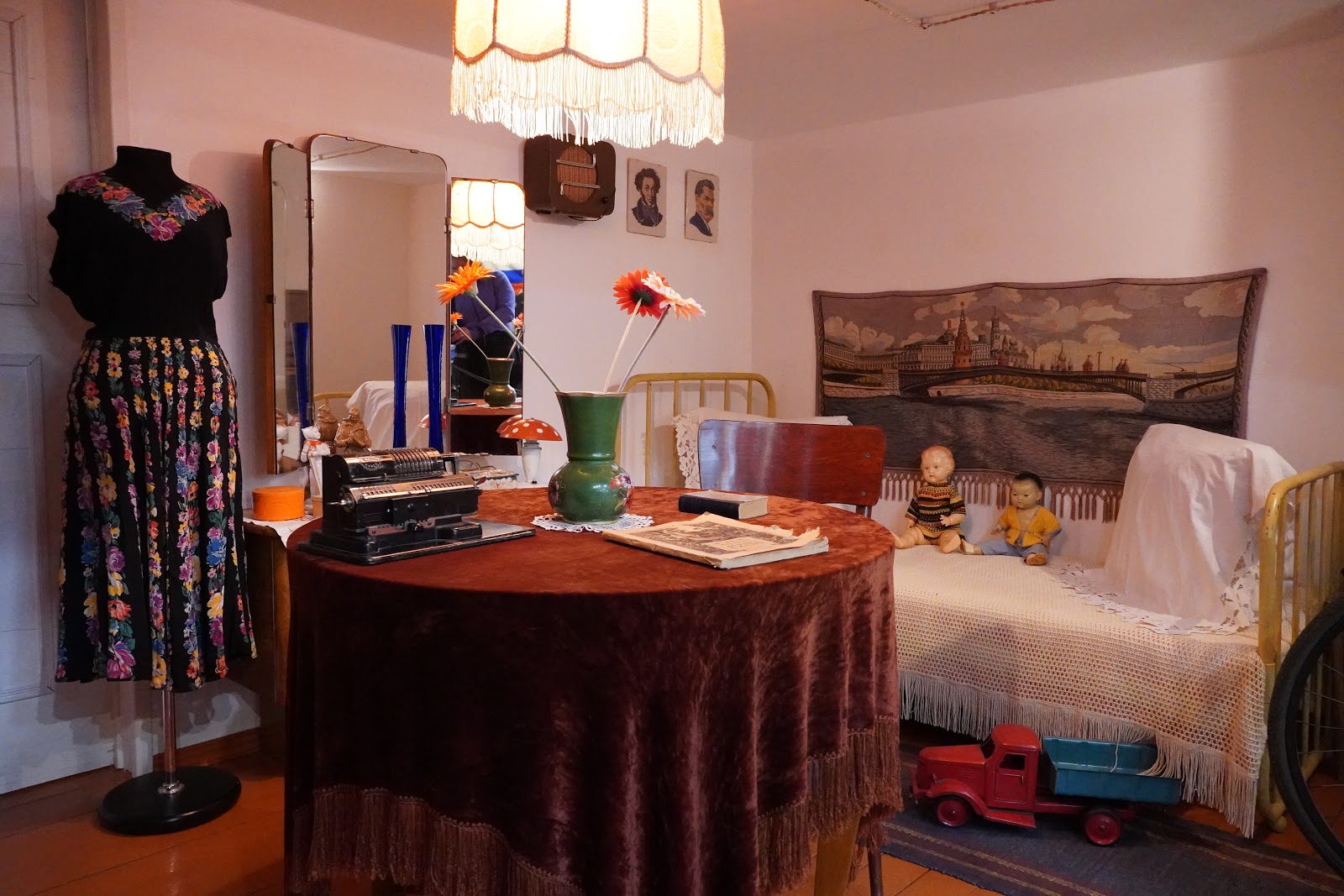
Almost across the street from the cat was my last sight of the trip: the city museum. Entry was only 60 rubles, so just under $1USD!! Considering how much there was to see, this was a great price. I really enjoyed this museum. 
Though there were no English signs or captions, the displays were set up in a way that I was still able to understand what I was seeing.
The displays were set up chronologically, with the major focuses being life here during the Soviet era, and the science industries of the city. There were photos and items and dioramas throughout the entire museum.
The museum was also hosting a temporary exhibit, a display relating to the artworks of Henri Matisse. Go figure, it cost more than the normal museum exhibits, but oh well.
After leaving the museum I walked to a cafe for a snack, then back to the train station for the easy ride back to Moscow. I'm not sure I would say Obninsk is pretty, but it probably looks better in weather that has some kind of colour.

02 June 2019

russia: dubna


When we went to Chekhov, our very last stop in town was a small museum. In one corner of the museum was a computer with a list of random museums around the area. The sights listed were mostly estate museums, or house museums, or random things to see.
One of the sights listed was the second largest Lenin statue in the world, in a city called Dubna. We knew absolutely nothing about the city, we hadn't even heard of it, but when we found out about a statue of Lenin that was bigger than all the others we'd seen, we were in.
Dubna has about 70,000 residents, and is around 130 kilometers from Moscow. It's the northernmost city in Moscow oblast, and is easy to reach by public transport. The city is built at the confluence of a bunch of waterways. The Volga River divides the city in two, and the Dubna River is basically the border of the backside of the city. Another side of the city is bordered by the Moscow Canal.
The city was founded as a fort in 1132, which existed until 1216. Wikipedia goes on to mention a number of villages that were in the area, I'm not sure what these have to do with the history of Dubna. 
The city was actually the location of one of the first collective farms, after the Civil War was over. According to Alexandr Solzhenitsyn's book 'The Gulag Archipelago,' Dubna was built by gulag prisoners. (Now that I've learned that I'm not so sure how I feel about the city.)
Dubna has the official designation of 'town of science' because it is home to the Joint Institute for Nuclear Research and a few other science related organizations.
As I said earlier, Dubna is an easy city to reach by public transport. Easy to get to, but not particularly quick to get to. 
Our train left Moscow at 0716, which is always tough on a Saturday morning; we arrived at 1003. There are two train stations in Dubna, we opted to get off at the first one the train goes through, as it is closest to the giant Lenin statue. This particular train station mentioned the science city designation right along with the name of the city.
We started walking toward the Lenin statue, my phone gave me a map that looked fairly straightforward. Right up until we got to a blocked off road. Uh oh. 
All of us knew immediately that if we weren't able to go this way, we probably wouldn't see Lenin, as going allllll the way around was going to be a very long walk. 
We looked to the side of the road closure, and noticed a very distinct path, so it seemed plenty of people had gone around the barriers by foot or on bikes. We decided to do the same.
Around the next corner we figured out why the road was closed. It goes through a tunnel under part of the damn that blocks up the Volga River. At least that's how I understood the location of the tunnel. 
This wouldn't normally be an issue, but one look at the ceiling of the tunnel told us it hadn't been kept up as well as it should have. Since the road is closed to vehicular traffic, that told us they didn't want the vibrations of cars traveling through the tunnel until it is fixed. While we walked through the tunnel several folks on bicycles passed us, so we didn't feel badly for going around the barrier.
Coming out the other side of the tunnel we kept following the road until we got to a stadium of sorts. I'd call it a water stadium. It was a seating area, along the water, so people can come watch boat races and the like. Pretty cool.
It took a bit longer, but we finally got to the Lenin statue. This one is the second largest in the world, after the statue near Volgograd. This statue is 25 meters tall, and sits on a 12 meter pedestal. Needless to say, we looked quite small in our team photo, and I had to set the camera a bit further back to make sure we got the whole thing in the photo. His pose wasn't anything out of the ordinary.
He stands on a small island between the two sides of the city. When he was built, there was another huge statue on another side of the waterway, this one of Stalin. 
We were disappointed to learn about the prior existence of the Stalin statue, (it would've been neat to see,) it had been taken down in the 60s, when Stalin wasn't very much in favour anymore, and there was an official period of de-Stalinization.
While we were looking at the man we heard a buzzing noise and realized another visitor had brought a drone. It was then that I decided I don't want a drone. While I can appreciate the photos they can take, I won't get those views myself, so I don't want to take those photos. And the noise is really annoying.
As Dubna sits on the water, there are quite a few little fingers of land sticking out, so there are quite a few small lighthouses. None of them were particularly unique, and none of them were big, but I always find them photogenic. I don't know how many of them are regularly used, if any. We walked to one of them, and saw others on the other sides of the water.
From there it was quite a long walk over the dam, to the center of one side of the city. Along the way we passed a couple science related monuments, one of which was dedicated to missiles, and a park that had a monument of a MiG-25 jet on one side.
Our next intended sight was the museum for missle history. Dubna is one of the places in the country where missile research is done, one of the displays was a map with other cities who also have missile research facilities. The museum was clearly not visited very often, as there wasn't even a ticket desk, though an employee chased us down to pay an entrance fee when we started to walk through the displays.
One of my favourite exhibits was a photo from when both the Lenin and Stalin statues still stood. I love old photos. There were also models of various missiles and the planes that carry them. 
A lot of scientific information that didn't mean much to me, as I'm definitely NOT inclined toward science.
We walked a ways to get to our next sight, a wooden church. It was surrounded by wooden walls, and there was another smaller, wooden church inside the walls, but it wasn't open. I liked the inside of the church, as the iconostasis up front was filled with colourful icons.
To get to our next sight, we took a taxi. I was keen to walk, but Claire and Angela were getting tired, and it would've been another long-ish walk. 
This sight belongs on the list of quirky monuments, it was a giant chair. Yup, a giant chair. I don't know how big it is, but it's big enough that you can't climb up to where you would normall sit. Very very big.
Near the giant chair was a monument that showed Dubna as being the center of Russian Europe. I'm not sure if this is true, but it was neat to see. Just down the street was another church, this one surrounded by a construction fence, as it was being renovated. The inside of the church wasn't very interesting, oh well.
At that point we were all ready to go back to Moscow, especially because we knew the train ride would be nearly three hours. We called a taxi, which took us to the other train station, from which we caught the next elektrichka back to Moscow.
I'm pretty sure we missed at least one museum in the city, so I wouldn't mind going back for another day trip.