20 January 2020

ukraine: kyiv for another khreshchennya

Winter this year in Moscow hasn't been very wintery. It still feels like late fall, the ugly part of the season. The weather has been the same in Kyiv, much to my disappointment. Despite this, I decided to return to Kyiv for another year to take park in khreshchennya, the 12th day of Christmas, when Jesus was baptised in the River Jordan. This takes place each year on 19 January in countries that have Orthodox Christianity.
Since you can no longer fly directly from Moscow to Kyiv (thanks to the ongoing political mess between the two countries,) I went for the next best option: the train. It is easy enough, but it involves waking up twice in the middle of the night for border controls. 
Thankfully, this year I wasn't pulled for a random interview, just a few questions while the officer was looking at my passport.
My train arrived on time in Kyiv, back to one of my all time favourite train stations. It's grand and traditional, and I love it. After arriving I went to a fast food restaurant across the street to charge my phone and use wifi. After hanging out there for an hour I walked to the accomodation I'd booked.
There was no sign on any door of the building where my hostel was located, but I noticed that there was a wifi signal with the same name, so I climbed the stairs, hoping eventually a door would have a label. Thankfully, it worked out well.
After getting myself sorted for another hour, I started walking again. Since I lived in Kyiv for six years I have seen a lot of the city, so I wasn't aiming for anything in particular, I just wanted to relax in a place that still feels comfortable, like home.
The first place I saw was St Volodymyr's Cathedral. It's a giant yellow church across the street from metro Universitet. Last year during our visit we walked past the church, this time I walked inside. Since this was the day before the holiday, there were plenty of people in the church. Even though I was there in the middle of the day, it was quite dark, as there isn't a whole lot of lighting inside.
The inside of the church is covered in frescoes, it's lovely. I watched people and absorbed the atmosphere for a few minutes.
From there I walked down the hill, passing the pedestal on which the statue of Lenin used to stand. The bottom of the pedestal is now painted blue and yellow, (Ukrainian national colours,) and there is currently a contemporary art piece in front of it.
I arrived at one end of Khreshchatyk Street, one of the main streets of the city. It was rebuilt after the war, by the Soviets. Because of this it is a wide boulevard, perfect for tanks and military marching parades.
I stepped into the Roshen chocolate/candy store (owned by the former president Poroshenko,) and found my favourite toffees, yum. It's not amazing, but it's good :)
At the other end of Khreshchatyk is Maidan Nezalezhnosti, or Independence Square. It has been turned into a sort of living museum, with signs and information in both English and Ukrainian, descibing what happened in the winter of 2013 and 2014. The emotional reaction I had back then always comes back to me, and I always take a few moments to honour those who died for their country.
As I was walking through the area I noticed that the trade building has been fully rebuilt, it looks stronger than I remember it being during my first couple years in Kyiv.
I walked up the alley of the heavenly hundred heroes (I'm not exactly sure on the translation of the Ukrainian name,) with all of it's memorials, ribbons, and flags, thinking again about everything that happened during that time.
I decided to go see a building I hadn't seen since my very first year in Kyiv, the House with Chimeras. I'm not sure why the building was built, or what it was for, but it is eye catching no matter what. It is across the street from the official office of the president, so it was completely blocked off for several years during and after the revolution.
As I got there I saw that a small seasonal ice skating rink had been set up, and people were queued up to take their turn. Very nice, and there was music being played somewhere.
After taking photos of the carvings on the building, I turned around and walked back north. I'm not sure how I got there, but my next stop ended up being a random cafe, this one with a menu of croissant sandwiches. Yum.
From there I kept walking and ended up next to the Rada, or parliament building. The photo I've always wanted to take means standing in the middle of the street, so I've never taken it. (I don't trust Ukrainian drivers, just like I don't trust Russian drivers.) I don't know how often politicians are in the building, or how much power regular Ukrainians have in making changes to their country's laws.
Behind the Rada is a palace that has never been open since I first arrived in Kyiv. It is always mentioned in the guidebook and travel apps as a sight, but that's not accurate. You can see the outside of the building, and it's gardens, but only from a locked gate in front. The gardens seemed more cleaned up than in previous years, so who knows, maybe there is a plan to eventually open the land and building to visitors. I hope so.
That brought me to Mariinsky Park, which follows the river for a bit. The weather was dark and cloudy, I couldn't see the other side of the river, booo. I followed the paths through the park, all the way until the big platz with the Friendship Arch. 
I think it was given by the Russians to the Ukrainians in the days of the USSR, I'm pretty sure it wouldn't be given now.
Side note, the arch was painted in a rainbow during the weeks Ukraine co-hosted the Euro cup with Poland, in 2012, in an effort to show how tolerant the country is. I love Ukraine, but tolerant it is not.
By that point the sun had gone down, so I was able to see some of the city lights, those that weren't covered by clouds. It's always a nice spot.
From there I slowly made my way back to my hostel, stopping at a supermarket along the way to pick up dinner: ramen noodles. 
Despite the noisy roommates in the dorm room, I still got a lot of sleep, it felt good.
The next morning I packed up and checked out, then met Oresta on the platform of one of the nearby metro stations. Oresta was a colleague when I worked in Kyiv, we've kept in touch ever since I left the city.
We rode the metro a few stops, getting off at Obolon station. There we met one of her friends, Genia. (In this case the nickname is the short version of Evgeniy.) He drove us out the north side of the city to an area I've wanted to visit for a long time: the Kyiv Sea.
The weather was the same as the day before, meaning everything was gray. Gray water, gray clouds, etc... Even though there was no colour to be found, I could see why Oresta likes the area so much.
Some locals had chosen to go in the water for their 'baptism' in this area, there was a platform specifically set up for this. We arrived around 1115, so it wasn't yet too busy. By the time we got back to the car it was a lot busier, many more people hanging out near the platform.
We followed the path along the water for a while, it was nice. Quiet, and nice. Eventually we got to a man made beach area, with cute little huts that are probably great picnic spots in summer. Needless to say, it wasn't so lovely on this particular day, oh well.
We walked a little further so Oresta could show me something she'd found a few years previously: an abandoned bobsleigh track!! AWESOME!! There is a gate in front of the track, but there are huge holes in the gate, and a footpath has been worn around one side of the gate. 
Clearly it is regularly visited.
I decided to climb up onto part of the track, using the metal support under the track itself. I wanted to walk further along the track, but that would've meant trusting the wood that still remained, and I wasn't that confident. Plus, I was a bit worried about some of the nails sticking out in random places. Anywho, so fun!
We walked back to the car, and Genia drove us back to one of the metro stations in the city. When I lived in Kyiv it was called Petrovka. Sometime in the last three years it has been renamed, to Pochaina. Apparently the name Petrovka was too Russian. Sigh.
We took the metro to Hidropark, where I've always taken part in Khreshchatyk. As I knew it would be, the metro station was packed. It is probably busier that day than any other day in the year, even when people come to the park in summer. Ukrainians make the religious event into a giant party.
Since there was no snow or ice this year I decided to go in the water on the busier side of the river. Even without the snow and ice, it was still plenty cold, but I'm still glad I did it. Does taking part mean I'm fresh and clean for the coming year?
After drying off and getting dressed again, we went back to the metro station. Oresta went home and I went back to the city center. It was great to spend a few hours with her, catching up on anything and everything. I treasure my friendships.
Instead of trying to see more places in the city I decided to check out a new cafe, the Blue Coffee Cup. I discovered it had a good menu, good prices, good portion sizes, nice decoration and atmosphere, and good service. I might have overeaten, but I regret nothing :) I ended up staying in the cafe for several hours, just because I could.
After dark I finally got moving again, and started walking back toward the train station. I've done that walk so many times that I don't need to use my phone to figure out where to go. Getting back to Moscow was just as easy and smooth (though no one loves the two border control wakeups in the middle of the night) and coming west. 
I'll always be happy to go back to Kyiv. (And hopefully more of Ukraine at some point.)

15 January 2020

russia: lenin, danilov monastery, and holiday lights


Tuesday touring continues, I really need to get better about doing something or going to see something every Tuesday.
Like so many other places I've visited recently, I learned about the Danilov monastery on social media. It is a walled monastery near the right bank of the Moscow River, in Moscow.


Wikipedia tells me it has been the headquarters of the Russian Orthodox Church since 1983. The year of this designation surprised me, because that was during the existence of the Soviet Union, and I didn't think the state wanted anything to do with religion back then.


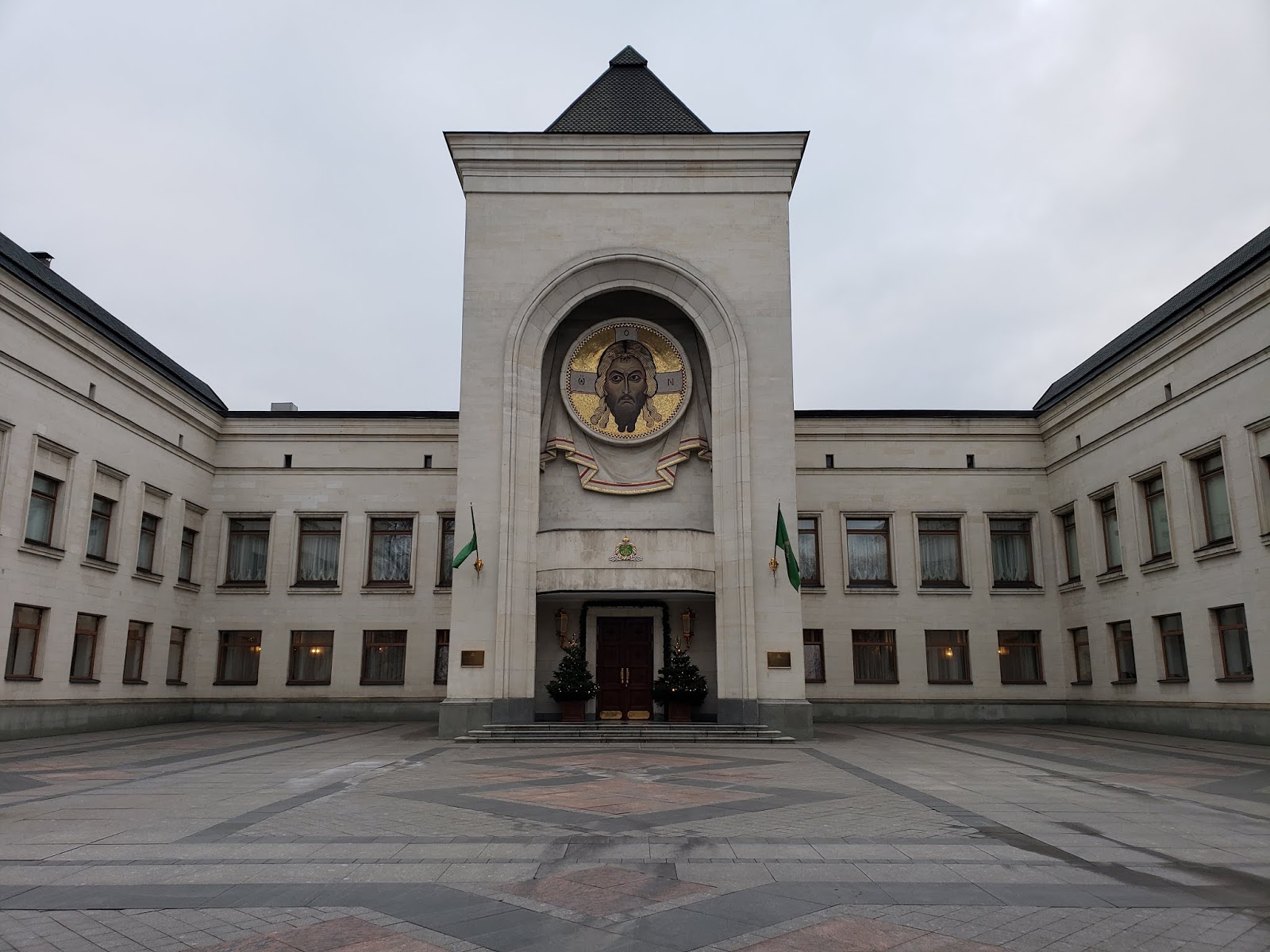
Danilov Monastery is the official residence of the Patriarch of Moscow and all of Russia. I'm pretty sure I know which building has his residence, there is a giant mosaic on the exterior wall of one building in the monastery. This building is blocked off from visitors, so that's my guess.


As with any religious facility in Russia, this one has a long history, including being moved around several times. First it was here, then it was moved to the Kremlin, then it was moved back. It was also used as a fort.
As far as I could tell, there were two main buildings that looked like churches. One is called the katholikon, it's actually three churches in one building. I went inside, and saw at least two areas, but I'm not sure about a third.


The other unmissable building was yellow, with big steps on all four sides and a dome on top. It wasn't open, so I'm not sure if it was a church or not.
After leaving the monastery I used the metro system to get to the area near the Cathedral of the Immaculate Conception. It's the big white cathedral on the list of most tourists.


The church is pretty new, at least the building is. Before the current church the location was actually a giant city pool for a long time, as the Soviet government did not want religion to be important in the life of any citizen. I've seen a few photos of the area when it was a pool and whoa.


There was a church there in the past, I assume it had the same name.
The reason I came to the area was to check out the holiday lights. The pedestrian bridge on one side of the church has a very non traditional series of Christmas trees. Think upside down cone, with lights spiraling around, and the cones leaning over to the side.


The other side of the church also had a couple sets of lights, which looked like shooting stars.

13 January 2020

united kingdom: england: chester and the canals

Chester is a walled city in England, a city with a long history. Wikipedia tells me it first existed as early as 79 AD, when it was founded as a Roman fort called Deva Victrix. This fort was bigger than others in the area, and some people think the Romans originally intended this area to become the capital of the Britannia Superior province. In some ways the original city design still stands, as the main roads of the modern city follow the same routes in which they were first laid out. None of the roads were completely straight, but that wasn't a thing back then.
After a while the fort turned into a settlement with civilians, not just soldiers. At some point the town became the 'possession' of what is now England. (I would assume this was when The Romans walked away, in 410.) Even though it was no longer officially Roman, it took a while for it to become properly English, but that's not a surprise.
As the city is really close to the border with Wales, a lot of the history has Welsh influence, though I don't understand all of it. And I can't pronounce the names to save my life.
Most of the city walls still exist, and are Grade 1 listed. (Meaning they are protected by legislation, and not up for sale or redevelopment or anything making changes.) You can walk along the top of parts of the wall, which is pretty neat.
Chester was granted official town status in 1541, and now has an official population of almost 80,000 people. Because of the walls, much of the city center has remained as it was back in the day. There is an area called Chester Rows, which is a series of streets with buildings that look just as they did centuries ago. 
I believe these buildings are also protected, so any renovations keep the look just as it was several centuries ago. We didn't go in any of the shops, as shopping is not something I typically enjoy, nor something I typically do while traveling.
The cathedral in the city (having a cathedral is what makes Chester officially a city, as opposed to a town; it isn't size/population that makes the designation,) was founded all the way back in 689. It is huge, with soaring vaulted ceilings, stained glass, gorgeous carved wood, etc...
I had never heard of Chester until September of this year. That was when my friend Claire boat a longboat, which is something she has wanted to do for a long time. As she says, people find you much more interesting when they find out you own a boat. I have to admit, I was much more keen to visit when I found out about her boat. 
I booked my flights to and from the nearby airport in Manchester, then took trains to and from Chester. Side note for anyone who cares: the Manchester airport is neither aesthetically appealing nor particularly easy for visitors to navigate. 
Going both ways one of my trains was delayed, but Claire told me that delays and cancellations are really common in England's privately owned train system. (Such a huge change from the system in Russia, which is amazing.)
I was in the area for 3.5 days. The day I arrived Claire and her partner Karl picked me up at the train station. We walked back to where they'd moored the boat, so I could drop my stuff. I had just a snackbag and backpack, but I'd been carrying them for a while and was ready to let go. 
We also ate lunch, which was nice. Buying the cheap ticket often means ridiculous layovers, and budget airlines, which also means no real food for long periods of time.
After eating we walked around Chester for a while. We walked along the city walls for a bit, which was fun. There are hills in the area, but nothing crazy, so the view from the tops of the walls isn't anything memorable. Claire laughed when I said everything was very cute, and very stereotypical, but to me it looked as English towns always do in movies and TV shows. 
We also visited the cathedral, because such things always catch my eye. It was well worth a visit, as it is beautiful. The ceilings in each area were well done, and still in good shape. There were giant stained glass windows all over, and I imagine the interior feels amazing on a sunny day.
The front areas had wooden pews/seats for the chorus, (at least I think that is who sits there? I could be totally wrong,) with some intricate wood carving. The end of each pew has a different wood carving. 
The carving of note was done back in the 15th or 16th century. It is an elephant, and was carved by someone who had never seen an elephant in real life. When you first see it you giggle to yourself, because it isn't quite accurate, but then you think about how hard it is to describe an elephant so that someone else could picture it properly.
Since this is England, the sun goes down around 1600. By the time we exited the church it was getting dark outside. We started to head home, with a stop at the grocery store. 
Even though I'd picked up snacks in the grocery store, I still wanted more 'real' food for dinner.
Or, as Claire called it, tea. I'm still confused as to what the names of English meals are. I think dinner comes at what I would call lunchtime, then there is tea, and late night food is supper? Anywho, we opted to have a chippy tea, which means we went to a takeaways place to get fish and chips and sausage for what I would call dinner. We only got two portions of chips (what Americans call French fries,) but that still more than enough for the three of us adults.
The next morning we started moving not long after it was officially daylight. Part of the reason Claire wanted a boat was to be able to cruise on canals. England has a great system of canals, and cruising was something I really wanted to do during my visit.
The weather started out gray, but with no wind, so I thought everything was beautiful. The clouds slowly gave way to a mostly blue skies, I was in heaven the entire time. There were lovely reflections of the skies and boats in the water as we cruised along. 
We ended up cruising for a bit over four hours before turning around and coming part of the way back toward Chester. I got to drive for a while, which was fun too. 
We moored in the middle of nowhere, then Claire cooked tea. I think it was quite traditional, as we had bacon, eggs, beans, and blood pudding. It was a first time to have blood pudding for me; I don't dislike it but I don't love it. Claire is a good cook, I've always enjoyed what she makes. 
As we'd moored in the middle of nowhere we had an unobstructed view of the lovely sunset. If I had a boat I'd hope for that kind of experience every day.
The next day we had a bit of an unintended adventure, as a band in the engine broke not too long after we started cruising back toward Chester. It took some time, but Karl was able to sort everything out, and used the spare belt to get us going again. I'm glad he figured out what to do, as I would've called the rescue service to have them take care of us.
Not long after tying off in Chester Claire and I got off the boat and walked back to the train station. Another reason I'd wanted to come visit Claire was the chance to meet her mom. Since Claire and I had traveled together over the past couple years, I knew Jenny had seen a bunch of my photos. I'd heard stories about her and wanted to put a face to the name.
The three of us met up at the train station, then walked through the city center, back to the cathedral. 
I hadn't seen it during our visit on my first day, but there is a cafe in the refectory area of the cathedral. The refectory ceiling is just as high as the rest of the cathedral, and it has stained glass windows as well. We had tea (the drink, not the meal,) and chatted for a while. It was a nice way to get to know Jenny.
On the way to getting Jenny back to the train station we stopped at the grocery store again. I picked up more snacks, including ingredients for tea (the meal, not the drink,) that night. I'd go to a grocery store every day if I could.
That was my last night in Chester. While we were relaxing in the evening I sorted out checking in online for my flights, which wasn't the easiest, as I'd made the bookings through a travel company.
The next morning I packed everything up, and the three of us went to breakfast. Going out to breakfast is a modern thing, and probably comes from American influence. The cafe we visited was called Hanky Panky Pancakes, so it definitely comes from American influences. What Americans would call a pancake is what the English would call a Scotch pancake.
After eating we went by a bakery so I could pick up snacks for my flights back to Moscow. I had tickets for budget airlines for both flights, and I didn't want to go hungry. Plus it was a chance to have food from an English bakery, which is completely different from what you'd get from an American bakery. I ended up loving my curry rolls, and pasties.
I opted to take an earlier train than I'd originally planned to get back to the airport, and that ended up being a good thing. It was 20 minutes late, but starting out ealier meant I still had plenty of time for transferring to my second train, which was on time.
Getting through security at the airport took quite a while, as they were opening up a lot of bags. The lady in front of me had to wait for a special check because the holiday gnome she'd bought had been flagged by the machine. I was glad I'd gotten there three hours before departure.
I'm definitely going back to see Claire and her boat again :)

08 January 2020

russia: vologda


Vologda was the last place I visited during the second part of my New Year's holidays. It is listed in my guidebook, and is conveniently located a night train's distance from St Petersburg. Wikipedia tells me the 2010 census shows more than 300,000 people live in Vologda.
Surprise surprise, Vologda is another Russian city with multiple founding dates in the city history. The oldest date is 1147, which would make the city as old as Moscow. This date comes from a guy in 1780 who was writing a book called 'Stories and Miracles of Gerasimus of Vologda.' 
According to this book that is when the Trinity Monastery was founded, so official city documents use that date as when the city was founded.
Even though this is the official city date, Wikipedia goes on to tell me that this is the wrong date. There is no scientific evidence to back up a founding year of 1147. Scientific evidence does back up a founding date in the 13th century; the city was mentioned as a possession of the Novgorod Republic in 1264.
When Ivan IV (usually known as Ivan the Terrible,) was in power Vologda became a center of trade, via the White Sea. 
At the time, most of the trade with foreign countries was with England, Holland, and other western countries. In 1566 Ivan traveled to Vologda to supervise the founding of a new fortress, on the Vologda River.
One of the churches inside this new fortress was Saint Sophia Cathedral, which was the first stone building in the city. Until then, everything had been made of wood. In 1571, before construction was finished, Ivan left the city, and never returned. 
Legend says he wanted the church demolished, as he had received a head injury when a small rock had fallen on his head, and therefore he considered the whole thing unlucky.  The church wasn't demolished, but wasn't consecrated until after he died.
In 1612 Lithuania took control of the city, and burned it down. Not long after, the city was able to rebuild itself pretty quickly, and use its location as a center of trade as an advantage to bring in money. Vologda continued as a center of trade for a while, and when Peter the Great became tsar he made the city host to a main military base.
Vologda lost much of its trade importance after St Petersburg was founded in the 18th century. The city began to decline, but when Catherine the Great became empress it started to grow again. When railways connected the city to Moscow, St Petersburg, Yaroslavl, etc..., businesses and trade started to grow.
Though Vologda is not considered to be part of Siberia, it was also a center of exile. Wikipedia tells me famous people like Stalin and Molotov were sent to Vologda for a time.
Near the end of WW1 Vologda became the 'diplomatic capital' of Russia, when some countries were worried about the safety of their embassies in St Petersburg and moved them temporarily to Vologda. This lasted only a few months, until the Bolsheviks kicked everyone out of Vologda and the whole country if I understand correctly.
WW2 wasn't good to Vologda, as it became one of many fronts after the Finnish military crossed the border. Residents dug trenches, built bomb proof shelters, and industrial organizations switched to military production.
After the fall of the Soviet Union, it took Vologda a few years to sort itself out. The political change happened in 1991, but the first elections in Vologda didn't take place until 1994. That being said, the city has sorted itself out, and is now the capital of the oblast.
I arrived in Vologda before sunrise, so I sat in the train station for a little while, staying warm and figuring out what I wanted to see/do during the day. As soon as I left the station I saw a city sign, so I made my first photo of the city straightaway.
From there I walked all the way to the accomodation I'd booked. 
I found the address easily enough, but figuring out how to get in was a different matter. There were two doorbells, and I rang them both several times, but no one answered the door. I called the number on the booking, which turned out to be a family member of the guy managing the place, then they called the guy, then he opened the door.
I got settled in, then relaxed for a couple more hours. Eventually I went back out, and headed toward my first sight, the kremlin. The kremlin is the fortress I mentioned above, built in the mid 16th century. It is still the main sight in the city, and based on the crowd, is popular with locals, not just tourists. When I got to the platz just outside the kremlin I found holiday decorations, as well as a holiday fest taking place, complete with music, games, and food.
I went into the kremlin area, noticing that one of the churches was closed for renovation. (This probably means I'll never see the church, as these sorts of renovations tend to take years.) 
I was cold and tired, and as it was Christmas Eve (6 January,) I didn't see much open. The area inside the walls was actually pretty small, but I think there are normally several museums in there.
After leaving the kremlin, I walked toward the first of three Lenin statues in the city. This one was the biggest Lenin.
Not only were there three Lenins, they were all pretty close to each other. At this point the weather was super windy almost nonstop, with clouds rolling through really fast. 
In the sun, it felt great, when the clouds came, not so much. I got to Lenin number two just a few minutes later, this one had his name spelled out, which I've found is not terribly common.
Lenin number two was on one side of Revolution Square. On another side of the square was the 0km mark, showing the spot in Vologda from which distances are measured. I like these kinds of monuments.
In the platz itself was a war memorial, with an eternal flame.
Lenin number two also wasn't far from the Church of John the Baptist, which is where I went next. It was warm inside, the interior was quite small. 
The iconostasis wasn't exciting, but I liked the carpets spread around the floor.
When I walked out of the church I headed toward one of the bridges over the river. Along the way I walked through a small park with another war memorial in the middle, this one had names and the dates of the war.
Next to one side of the bridge was a quirky monument. A dog lifting his leg next to a pole is supposed to memorialize the first lamp post. Kinda cute, kinda not. 
At this point the light was starting to change to the blue light that comes before sunset. Even though I hadn't been out and about for very long, I decided to get dinner.
Vologda doesn't have a huge number of restaurants, so I settled on pizza. After pizza I found a branch of a coffee shop I'd visited in Nizhny Novgorod, I remembered it as having really good chocolate cheesecake. Needless to say, I was more than happy to have it again.
When I'd left the hostel earlier in the day, the manager showed me which doorbell to use when I came home in the evening. 
I used that doorbell, but it didn't make any sound. I called him directly, and said I was home, and he came out to open the door. I told him neither doorbell worked, but I don't think he understood me. Argh.
The next morning I packed up and checked out, then walked back to the train station to drop my bag for the day. It was a long-ish way to go, but I didn't want to have to deal with the lack of working doorbells and leave my pack in the hostel all day.
From the train station I had another long walk, all the way to a big monastery. The walk from the train station to Spaso-Prilutsky monastery was over eight kilometers, and took me a couple hours at least. I don't walk all that slowly, but I do stop regularly for photos, and on this day I had to walk through snow a few times.
A few mini snowstorms as well. The kind where everything is lovely, then ten minutes of not seeing where I'm going, then back to clear-ish.
Not far from the monastery I saw a double train bridge, which was just neat to see. 
I assume trains going one way went on one bridge, then trains coming the other way go on the other bridge, but I don't know. I like bridges, it was neat to see two of them so close to each other.
Spaso-Prilutsky Monastery looks like someone played with different sets of Legos to put it together. A couple of the exterior walls are red brick, two others are white. The various towers around the whole thing are of different styles too. Nothing matches. Weird.
The monastery was first established in 1371. Like most religious facilities, the Soviet period was not good for the monastery. It was abolished in 1924, and the buildings were used for private residences, a prison, a depot, and a museum. Thankfully, all the buildings were preserved, just not used as they were originally intended. The monastery reopened in 1991, and still functions as it was meant to.
I wandered through the areas I was able to see, there weren't many. I also walked along the tops of the walls, which were open for this. I love walking on monastery and fortress walls.
Even though the walk to the monastery took a while, in then end I was there for just 30-45 minutes. The walk back wasn't quite as long, since I only walked to the city center. After getting back to the city center I went to see Lenin number three, and made a photo with him. He stood in front of the main university in the city.
After visiting with Lenin, I felt as if I'd seen what I wanted to see in Vologda. I went back to the coffee shop from the day before, eating a full meal before having another piece of chocolate cheesecake. 
I was in a seat near a plug, so I took the chance to charge my phone for a couple hours before walking back to the train station.
I guess I was in a cheapskate mood when I booked my ticket back to Moscow, as I booked a seat, not a bunk. Trying to sleep while sitting up is hard enough, it was even harder because the lights came on every couple hours when there were bigger stops. Argh. I was knackered when I finally got back to Moscow.
I would go back to Vologda, though I'd prefer to do it in warmer weather. Since this visit, I've looked at the city map, and found a few more things to see :)