Showing posts with label UNESCO. Show all posts

21 July 2020

russia: petrozavodsk and kizhi island


When my train arrived in Petrozavodsk in January it was a cold, rainy/snowy/windy day. Walking from the train station to the hostel I'd booked was miserable, as the sidewalks were covered in snow, slush, and puddles of icy water. By the time I got to the hostel that day I was not in a great mood, simply because of the weather.

This time my train arrived in the middle of the night, just after 0300. Since Petrozavodsk is quite far north, the sky was already changing colours, though my phone was telling me official sunrise wasn't until 0337. I hung out in the train station until around 0730, so I wouldn't arrive at the hostel before anyone was awake. 

The walk this time (compared to January,) was sooooo much nicer.

Just like in Vologda, Petrozavodsk was completely different 6 months after my first visit. Instead of gray and cold with some white and lots of rain, I got to see all the colours of the rainbow. Green grass and blue skies, it was glorious. It was hot and sunny, I was happy to wear shorts and a t-shirt.

After checking in and resting up for a while, I walked to see Lenin, even though I'd seen this statue in my first visit. 

He hadn't changed (of course,) but the atmosphere of seeing him did. (Sunny and hot vs windy and snowy. He stands in the middle of a small traffic circle.

Off one side of the traffic circle is a park. The edge of the park right there had an 'exhibit' called Victory. There were large letters spelling out POBEDA, and a whole bunch of red flowers. Well done.

From there I walked back to Kirov square, where I'd seen the small Christmas festival previously.

There was nothing set up this time, as it was summer, at a time when it was not a holiday. What I did notice though was the big construction fence around the monument I saw last time that was a 'tree' with 'leaves' showing each sister city of Petrozavodsk.

I kept heading 'down' the hill, ending up at the lake. When I got to this point in winter it was already feeling dark, even though it was only around 3 in the afternoon. 3 in the afternoon in Petrozavodsk in summer is a world of difference. Walking along the lake was absolutely lovely, even though there were a lot more people out and about.

I walked further than I had in winter, just enjoying the atmosphere. During this walk I noticed there are actually a couple small beach areas, real beaches! Not only do the beach areas exist, there were people laying out, and other were swimming. I stepped in the water for a minute, but it was quite chilly, I had no desire to swim properly.

At one end of my walk I realized I was standing by an office where I could book tickets to take a boat to Kizhi Island, which had been on my Russia bucket list ever since I got my first Russia guidebook from Lonely Planet. (A church from the island was on the cover of that particular edition.)

I paid for my ticket, and was thrilled to know I'd get to see a UNESCO sight the next day.

From there I walked through a small amusement park, which was pretty busy. I don't know if it had just opened for the summer, and people were there because they hadn't been able to be there since the previous summer, but it seemed quite crowded to me for a Tuesday afternoon.

Dinner that night was from the supermarket: yogurt and ramen noodles. (Not mixed together, of course.) I went to bed early to make sure it would be easy to get up the next morning in plenty of time to get to the boat dock on time.

The next morning I decided to stop at a bakery on the way to the boat dock, yum. Worth it even though I had to walk pretty fast to get to the dock on time. We all queued up and boarded one by one, there were no Covid safety measures other than a request to wear a mask the whole time.

I dozed off during the 90 minute hydrofoil ride, hee hee.

Arriving at Kizhi Island was easy, though busy. The people who know what they're doing try to get off the boat first, because you immediately have to queue again, to buy tickets to enter the island.

The whole island is an open air museum, so if you don't buy this ticket, you'll have just been on a boat for no reason at all. (Why the tickets aren't combined I don't know.)

Like most people, I headed south just after buying my ticket. This is in the general direction of the most famous spot on the island, a beautiful church with a zillion onion domes. All made of wood, all quite intricate. You can easily identify which church was recently renovated, as the wood all looks very new. Very very new. 

There are two churches in this particular area, surrounded by a large wall. I chose to look at everything from the outside first, then circle around again, after the crowds had lessened a bit. The main church has recently been renovated, and as far as I could tell, is still not open for visitors. So you can go inside the walls, but not inside that church. You can enter the smaller of the two. Further south I found some hay fields, farm houses (open for visiting,) a windmill, a smaller church with a fantastic bell tower, and more. Some of the areas had little docks, where the owners can take out small rowboats/canoes on the water. 

Each time I entered a building I had to put on my mask and use some of the antibacterial/disinfectant stuff on my hands. Nearly all the employees fell into the 'old' category, so I was fine with taking these precautions. It was neat seeing how some people used to live, in terms of furniture, activities that had to be done regularly, and supplies kept on hand all the time.

Other than trying to avoid people, it was a lovely day wandering all over. There is a small village on another side of the island where people still live, and a few cottages you can rent for holidays. 

All in all it is quite picturesque, and very relaxing. There is a small graveyard in the middle of the island, some of the gravemarkers were quite old, and many pictures had faded to almost nothing.

When you buy a boat ticket it has a specific time to board the boat, you can't just rock up for any of the boats going to and from during the day. I got back to the main dock area in time to buy postcards and a magnet, then board the boat. Just like on the way to the island, I fell asleep/dozed on and off on the way back to Petrozavodsk.

After getting off the boat I walked along the lake for a while and made my way to a memorial in a small park, this memorial was for the victims of the NKVD/KGB/FSB. Nothing exciting, and based on the number of families just hanging out in the park, I doubt most of them were even 'aware' the memorial was there. (When you walk past something so many times you don't even remember it is there at all.)

I went to bed early that night because I had to get up early in order to catch a train at 0535. Now that I've seen Petrozavodsk in both winter and summer, I don't think I need to go back. On the other hand, the city does have the chain of bakeries I really like, and I've been known to travel for crazier reasons, soooooo......

28 December 2018

sri lanka: polonnarua, sigiriya, dambulla


Before I booked my flights to/from Sri Lanka I heard so much about how cheap the country is, how great the food is, how beautiful the country is, and how amazing the culture is. The last three of those were true, but how cheap the country is depends on quite a few things.
The first being where you are in the country. On the beach, I spent very little money. In the mountain towns I spent very little money. But in cultural capitals, with ancient historical sights, it was not cheap, or at least not nearly as cheap as I had been led to believe.
The main reason for this was the price of entry tickets to the ancient sights. There was always a much much higher price for foreigners to visit a place, than for locals. This post is about the next three places I visited in Sri Lanka, which all have ancient historical sights. The price for foreigners was usually arond ten times as high for foreigners, if not more.
Polonnarua was another city that was formerly the seat of royalty. It was built by the second big dynasty of Sri Lanka, the Chola dynasty. They built their city after invading and conquering Anuradhapura, waaaay back in the 10th century.
It wasn't hard to get from Anuradhapura to Polonnarua, it was just a (surprisingly cheap) bus ride. I'd seen all sorts of posts about hiring personal drivers, but that seemed unnecessary, as there were plenty of direct buses between the cities.
I was the only foreigner on my bus, which would normally make me crazy; this time it was nice because locals made sure I had a seat, and made sure I got off at the right place. Polonnarua isn't a big city, so no one else was getting off the bus there.
Since most of the people arriving in Polonnarua are foreigners, there are usually a few people waiting at the bus stop to grab the foreigners and find them places to stay. This is what happened to me, and it worked out well. I got a single room (with two big beds,) for a more than reasonable price.
After unpacking I went out for the day. It wasn't immediately obvious where to buy the entrance ticket to the ancient ruins, as it was not at the biggest section of the ruins. The price was just as high as in Anuradhapura, I was just as (un)happy about paying so much.
The ancient ruins of Polonnarua are extensive. I think I visited most of the ruins, and I enjoyed what I saw, but by the end I was exhausted. Much of what I saw was similar to what I'd seen in Anuradhapura so I was a bit mentally exhausted by the end of the day as well.
It was another beautiful sunny day, with plenty of heat and humidity. I again wore a scarf on my neck to prevent more sun being soaked up by the very sunburnt skin on my neck. This time I was ready for the heat and humidity, I carried enough water in my snack bag and bought snacks as I went along.
Throughout the day I saw the remains of a few royal palaces, stupas, living quarters, monasteries, etc.... To be honest, by the end of the day it all looked the same. Some of the areas were busy with tourists, others were completely empty. I assume the busy sections were those on tour itineraries, the empty sections not so much. I don't know if that reflects on the 'importance' of each area.
Some of the religious areas are still considered holy, so I had to take off my shoes to see them. Other areas are not holy, so I kept my shoes on.
Since the on and off game with my shoes had started a couple days earlier, my feet were already raw, but I knew that wasn't going to get any better for the next few days. I probably looked like an old lady at times, hobbling around on burned feet while stepping on hot stone.
One particularly memorable section of the ruins at Polonnarua had the remains of a really really big Buddha on the back wall of a temple. This one stuck with me more than others, though I don't know why.
I loved the day of 'seeing' history, but it was a very long day, with a lot of walking. I had dinner at a random cafe, then walked home. When I got back to my accomodation I discovered that the wifi didn't reach into my room, so I sat out on a balcony of sorts. The mozzies ate me alive, but oh well.
The next morning I was up quite early in order to get a ride to the bus station in order to catch a bus to my next ancient cultural capital: Sigiriya.
The bus didn't actually stopped at Sigiriya, which isn't really a town. It stopped at the next town, where there were a few tuk tuk riders waiting for passengers like me. I was ready to walk to Sigiriya when the first driver proposed his price. 
I still overpaid when I ended up paying less than half of what he suggested, but he did drive me straight to a place to stay, so I chose not to care too much.
The place I stayed included breakfast in the price, but I knew I'd be leaving early the next morning, before breakfast was service. I was able to have breakfast on the day I arrived, instead of the next morning. Yay. Like most included breakfasts, it wasn't necessarily local food, because I'm pretty sure Sri Lankans don't eat sweet rolls for breakfast. 
Sigiriya is sometimes called the Lion Rock, it is on top of a 200 meter high rock that sticks up out of the landscape. The 'current' sight was made by King Kashyapa, who chose the location to build a fortress/palace to use as the capital of his kingdom. The building for this fortress palace took place in the 5th century. I don't know Sri Lankan history well enough to know where this king fits in the whole chronology.
The actual history of the area goes back a lot further, probably back to at least 300 BC. And that's just for documented or proved history. Legends go back even further.
Sigiriya is a small enough area that most visitors come for just half a day. This one had an even higher price than the previous two places I'd been, with an even bigger difference between the local and foreigner price. I was so mad.
Since the ruins are on top of this huge rock, you have to climb a whole lot of stairs to get up there. There are a couple wider sections of stairs, but most of it is single file, which means major traffic jams of people. NOT FUN.
There was one section where being a foreigner was a benefit: we were shown to go up a section of stairs that was basically a shortcut up to a higher section. Locals were not allowed to go up this section. In the wider sections of the stairs there were a lot of locals jumping the queue, much to the frustration of every foreigner.
The most memorable section of these ruins were the giant lion's paws midway up the rock. This is where the name of the rock comes from, as they were the official gateway to the sight back in the day.
The top of the rock was nothing different from what I'd already seen. I still walked around all of it, but didn't stress about taking as many photos. From my point of view the best part of these ruins were the views over the entire area from the top of the rock.
After coming back down to ground level (more skinny stairs, yippee,) I walked around the less interesting ruins at that level. I liked the ponds, because I could see pretty reflections :)
Since Sigiriya is a village built up around a tourist sight, everything there is support for the sight. I had a late lunch/early dinner at a small cafe, the price was higher than I'd paid previously because it was not a place locals would eat. (The food was pretty good though, and I was left alone, woo hoo!)
By the time I got back to my room I was suffering from heat exhaustion, and I had heat rash. Ugh. There wasn't anything else to do in the area, so I was okay with laying in my room, drinking water and enjoying the breeze made by the ceiling fan.
The next morning I was up early again, and caught a local bus to my next stop, the city of Dambulla. The modern city of Dambulla isn't very interesting, at least not what I saw of it. It is mostly stretched out along one road, and nothing is all that pretty. When I got off the bus a tout saw me and brought me to a place to stay. My room was nothing special, but I'm never in the budget range for my accomodation to be particularly noteworthy.
Historians say there has been human life in the area of Dambulla possibly as far back as the 7th century BC. I think they are able to carbon date things they've found in various cave homes in the area?
The only reason any visitors come to Dambulla is to see one of the best preserved cave temples of the country. Getting to the temple area was quite easy, the walk wasn't all that long from where I was staying. What wasn't fun were all the steps I had to climb. I guess I hadn't eaten or drunk enough, as I was feeling really weak while going up the stairs even though I was moving slowly.
Not surprisingly, there was a ticket office, and I think it was just for foreigners. Though the price was far lower than it had been during Anuradhapura, Polonnarua, and Sigirita, it was still heaps higher than for locals, who had to pay nothing. Argh.
These temples are still considered an active religious sight, so when I got to the top of all the steps I had to take off my shoes in order to enter the temple grounds. The whole thing is made of stone, so stepping on the bare stone without shoes wasn't fun, as it had been sitting in the hot sun for who knows how long.
This cave temple is actually a series of caves, most of them have a bunch of Buddha statues inside, and many of them are painted inside as well. None of them have amazing ventilation, they were all rather smelly.
A covered hallway/walkway has been built outside the caves, so visitors are able to go between the caves quite easily. It didn't take me all that long to see everything, and take all the photos, (never with any of the Buddhas behind me, as one should never turn their back to Buddha,) so I walked back down the hill and went out another entrance to the complex.
I also visited a very modern Buddhist temple, which was only a few meters down the street from the cave temple complex. This one was called the Golden Buddhist Temple, because there was a GIANT gold Buddha. Nifty, and again didn't take all that long to visit.
As both of these sights were on one end of town, and I felt as if I hadn't seen much, I walked toward the city center. At least, that's what I intended to do. After a while I realized there really wasn't a specific city center, so I just turned around. Dinner that night was just snacks from one of the markets I passed.
The next morning it was easy to get back to the bus stop and catch a ride to my next city.
As Anuradhapura and Polonnarua are basically visited for their ancient ruins, I don't need to see those again. Sigiriya is nothing but a tourist sight, and Dambulla is nothing in particular, so I'm not going back to either one of those cities either.

14 November 2018

russia: sergiev posad again


One of the best day trips Claire and I did during our first year in Moscow was to a small town called Sergiev Posad, about 80 kilometers slightly northeast of Moscow. The town (which has a surprising population of just over 110,000,) exists because a large monastery was built there, the Trinity Lavra.
The monastery was established (according to Wikipedia,) in 1337. It is still one of the biggest monasteries in the entire country, though I don't know if that means by size or by number of people living/working in the monastery. Another Wikipedia page tells me there are more than 300 monks working here.
Like most monasteries, this one started out as a simple (wooden) church, with other buildings added over time, including protective walls. It is named for St Sergius, (who is the patron saint of the Russian state. Apparently the way this monastery started and continued to grow was a model for the followers of St Sergius, they went on to build 400 other similar monasteries around the country.
The monastery was closed from 1920 to 1946, mainly because the Soviet government was not a fan of religious institutions other than the state itself. Stalin allowed the monastery to reopen in 1946, and it was the seat of the Moscow patriarchate until 1983, when that designation moved to a monastery in Moscow.
I really like the ceiling in the main church of the monastery, and I love the way light comes through the windows of this particular church.
It was easy for us to catch an elektrichka to the town; since Claire and I knew where to go it was much easier than our first visit. The weather was also better, which always makes a difference.
We walked around the grounds, looking in every building we could. Claire and I saw the onion domes of the church in the middle and felt as if the paint had faded in the last year, the blue didn't seem as bright as we remembered.
After walking all over the monaster we walked up the main street in town, going a little further than we had the year before. I finally took a picture of a mural on the side of a building, it was quite pretty.
We also took a team photo with a bust of Lenin, something I don't think we did during our first visit to Sergiev Posad. Come to think of it, I don't think we even noticed the bust of Lenin at all during our first visit.
In keeping with copying our first visit, we went back to the same cafe. I was keen to have more of the best fruit tea I've ever had, and we were hungry. I ended up ordering way too much food, but I don't regret it.
After eating and drinking we kept walking, heading to a new part of town. I'd spied another church spire, it made me curious. The church ended up being more picturesque inside than outside, (though not well lit, and quite dusty,) I'm always going to want to check out a church when I see one.
We went back to the train station and didn't have to wait long for the next train back to Moscow. Now that I've seen Sergiev Posad twice, in two different types of weather, I doubt I'll return.


12 November 2018

russia: yaroslavl


We chose to visit Yaroslavl for two reasons: one, because it was in the guidebook, and two, because it was one of the city names on the mugs in Starbucks.
Yaroslavl is a city of almost 600,000 people, around 250 kilometers northeast of Moscow. It is considered one of the Golden Ring cities around Moscow, because it used to be important politically, and was an influence in the early history of modern Russia.
Yaroslavl was officially founded in 1010, though there were Viking settlements in the area in the 700s and 800s. (The Vikings were a lot more spread out than most people know.)
It was founded as another city in the principality of Rostov Veliky, and became the capital of its own principality in the 13th century. In the mid 15th century it became part of the Grand Duchy of Moscow, and until at least the 17th century was Russia's second largest city. It was even the unofficial capital of the country for a while.
I'd argue that most people outside of Russia have never heard of Yaroslavl, unless they've studied Russian history. It no longer has any political influence on the country, and is now an industrial city. The city center, the historical area of the city has UNESCO designation, securing its cultural importance in history.
Yaroslavl was named for its founder, Prince Yaroslav. He was one of the princes who founded Kyiv Rus, which is basically the modern empire of Russia.
We took an early morning train on Saturday, it took about 4 hours. From the train station we caught a local bus to get to our accomodation. It was an apartment in a random block of flats, with interesting decor. It was definitely the first time I've seen a theme of England as decoration throughout an entire flat!
After hanging out for a bit, we walked out to explore the city. It was colder than we'd been expecting, and windy. It's not as much fun to explore a new city when you're cold. Each time I pulled out my camera and/or tripod my fingers got really cold, and took a while to warm up. Metal pieces just hold cold, and that cold goes right into fingers.
We saw a monastery and decided to enter the church. This was one of the churches that is more demanding about women wearing skirts. All three of us were wearing pants, but I was the only one asked to put on a skirt. My coat was a ski jacket, I guess it didn't cover enough of me; the coats Angela and Claire were wearing were somewhat longer.
Another ten minutes of walking brought us to the kremlin of the city. (A reminder, the word kremlin simple means fortress. The Kremlin is in Moscow, but many Russian cities have a kremlin.) The walls were painted white, and from the direction we approached it wasn't immediately obvious where the main gate was located.
We found the ticket booth, and discovered several options for tickets, I hate that. I'd much prefer two ticket options for a place like a kremlin: entry to all museums and the grounds, or just entry to the grounds. We ended up choosing to pay the grounds entry fee, as well as the entrance to the museum of treasure and shiny things.
To be honest, there wasn't a whole lot to see in the grounds of this particular kremlin. The churches weren't open, at least not that we could see, which was a shame. There were several souvenir shops, we stepped into all of them for at least a quick glance, and a minute to warm up.
We enjoyed our walk through the museum of shiny things, though the docents seemed to think we were idiots. We are foreigners, not idiots. Sigh. The displays were pretty good, all three of us enjoyed the shiny things :)
By the time we left the museum it was dusk. In terms of taking photos I hate this time of day on a cloudy day. Taking photos at this time of day has everything turning out blue. Ugh. We stepped inside the ticket office again (which was also a souvenir shop,) so I could look up ideas for places to eat dinner.
We chose a Georgian restaurant which ended up being really good. We were still cold when we finished eating, so we took a bus back to our flat instead of walking. 
The bus stop was a block away from where we needed to be, and there was a supermarket on the way between the two, yay.
The next day we packed up and put the key into the postbox for the owner. This day was sunny, but not any warmer. Even though it wasn't actually warmer, it felt warmer, at least in our minds. It was windier though, which was very noticeable.
We walked in a slightly different direction this time, heading straight toward the Volga river, one of the main rivers in the entire country. The city has developed a nice walkway parallel to the river, with a nice view of the water the whole way.
Walking next to the river made it feel even windier. Despite the sun we were just plain cold. We stopped to check out a couple churches, only one of them was open. I wonder if the sight of onion domes will ever cease being interesting to me.
Yaroslavl is said to have one of the largest number of churches in the Golden Ring cities. After our visit, we didn't doubt this statistic. They really did seem to be every block or two. Some of them had land around them, others were just a church. Maybe seeing so many churches in one area blurred them all in my head, but the churches of Yaroslavl all seemed somewhat similar in appearance to us. There were a lot of white churches with green onion domes.
We eventually made our way to a big platz in the city center. On one side of the platz was a lovely church, on the other side was a giant government building. Normally this is where I would've expected to see a Lenin statue, but we didn't see him.
We tried to find an open door to the church, but it didn't happen. Instead we had to settle for looking at the decorative tiling on the outside of the church.
At that point we realized we were absolutely frozen, at the point where it actually hurts. We found a nearby cafe just so we could warm up. It's not fun when your fingers ache from cold. After an hour inside, we hoped stepping back outside would be acceptable again to our fingers.
We saw a couple war memorials, one of which was quite close to another ginormous church. What stuck with me about this church was the beautiful decorative tiling around the main entrance door.
Another sight mentioned on a travel app was yet another church. The church itself wasn't particularly spectacular, but it was the church on one side of the 1000 ruble banknote, so that meant it was worth seeing. We took a local bus to get there, then walked a little more.
This was another church that wasn't open, argh. It wasn't big, and completely forgettable from the outside, so all three of us wondered why it had been chosen to be put on a banknote. Oh well.
We were happy to get back on the bus going back to the city center, as the heat was on high and felt so good.
We went back to the same restaurant for dinner, as we'd enjoyed ourselves the night before. As we moved away from the river, we felt the effects of the wind weaken, so we decided to walk back to the train station. The walk was broken into two parts when we stopped into a Starbucks for drinks and snacks. Since Starbucks was part of the influence in choosing this travel destination, why not?
Our train arrived back in Moscow just short of midnight, we were all able to take the metro back to our flats. 
I don't know if I'll return to Yaroslavl. Maybe if I'm in the mood for an easy trip, in a different season?

06 November 2018

russia: dagestan: derbent and mahachkhala


One of the official Russian holidays each year takes place near the beginning of November. National Unity Day doesn't seem to mean much emotionally to any of the Russians I know, but everyone loves a day off. It has fallen on a Monday for several years, meaning I get a three day weekend, woo hoo. (I can't wait until it falls on a Tuesday, then I'm hoping for a four day weekend.)
Three days to travel in my mind justifies flying somewhere a bit further from Moscow than my normal weekend trips. Claire had found a place that interested her, and since I didn't care where we went, all three of us booked flights to Mahachkhala, the capital of the Russian Republic of Dagestan.
Before moving to Russia I'd heard of Dagestan, but not for very good reasons. It is right next to Chechnya, which is still not the most stable of areas in Russia. Dagestan has had similar problems, as the history is quite similar to that of Chechnya. Chechnya has gotten a lot more recognition with the fighting in the region, but Dagestan has had some of it as well. Americans will recognize the name Dagestan, but not right away, and for an awful reason: the Boston bombers were both from Dagestan.
Dagestan has European Russia's southernmost point. 
Most of Dagestan is mountainous, the name basically means 'mountain land.' Throughout the entire area are ancient fortresses and abandoned cities. Wikipedia tells me this republic of Russia has the most heterogeneous population, with people from quite a few ethnic origins. All of these groups have their own language, but use Russian between each other.
Civilization has been documented in this region for a long time, nearly 3000 years. With the wide variety of peoples and languages and faiths in the area, much of the history has involved fighting. 
The two main faiths have been Christianity and Islam, though the current majority would consider themselves Muslim.
Dagestan officially became part of Russia in 1806, though that wasn't really confirmed until after the Russo-Persian War, because that is when Iran officially ceded the territory to Russia. Despite being part of Russia, locals haven't always been happy about this. There are regular rumblings about independence, which sometimes break out into violence. The republic is considered semi-autonomous, which helps keep the peace. 
Claire had mention Dagestan and Derbent early in the semester, so we'd been keeping track of the safety issues in the region for a couple months before booking our flights. There weren't any issues before, during, or after our visit, which should settle the minds of anyone who was/is worried about us.
Though Mahachkhala is the capital of the region, Derbent was where we chose to focus most of our time. Derbent is a city on the coast of the Caspian Sea, the southernmost city in European Russia. 
 Derbent considers itself the oldest city in Russia, as they have history going back to the 8th century BC. (The fact that it wasn't part of Russia back then seems to be ignored when making this claim.)
Derbent currently has a growing population of more than 120,000. Historical fighting here has been mostly between the Persians and the Arabs, with the Russians coming in in later years. While we were there we didn't hear any other English, and we saw very few ethnic Russians.
We took a taxi from the airport to Derbent, which took about 2 hours. 
Though we'd given our driver the address of the accomodation we'd booked, it took another 20 minutes of driving around to figure out exactly where it was. We were fortunate that our driver was willing to call the phone number and get directions straight from the owner.
After hanging out in the flat for a couple hours we went out walking. Derbent is on the Caspian Sea, and there is a beach, but we quickly figured out why there is no major resort part of the local economy. The wind never stopped, which meant fine sand was constantly landing on us. 
Hanging out on a towel on a beach wouldn't be fun if you walk away later covered in sand.
On this particular day the weather was chilly, with dark clouds rolling through really fast. Since it was early November, the water was nowhere near warm enough for swimming, I was the only one of us willing to get her feet wet. I wanted to say I'd been in the Caspian Sea.
We walked on the beach for a while, and that's about it for the day. Something about the red eye flight, waiting in the airport, and taxi ride had exhausted us. We picked up food at a supermarket, then went back to the flat and just relaxed for the rest of the day.
After breakfast the next morning we started walking. The weather seemed better, it wasn't quite as windy and the sky was mostly blue. We started by going back to the beach to be close to the water a bit longer.
The beach doesn't follow the entire coastal part of the city, it's actually a pretty small area, and much of it is not very pretty. We saw one guy fishing, who looked at us like we were crazy. Apparently people don't hang out near the water here. The Caspian Sea has fishing restrictions now, because of overfishing, so I have no idea how successful this fisherman was, or if he was supposed to be there at all.
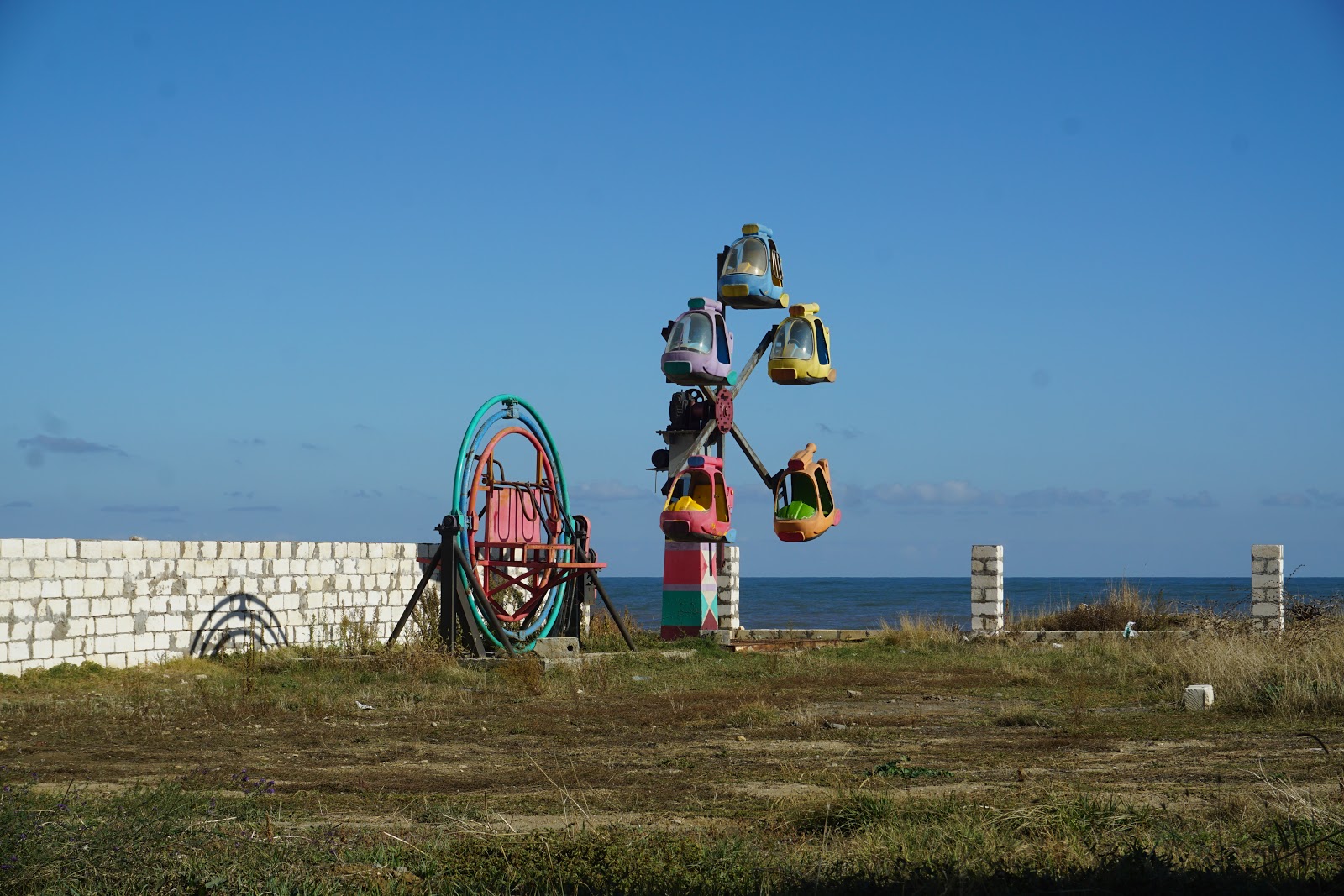
We saw what might be called an abandoned amusement park, though it was really just three or four rides that had been left to rot. Photogenic in a way, but not important at all.
The first real 'sight' we tried to see was a lighthouse. When it was built, it was on the coast. It is no longer anywhere near the coast, there is no way a ship should be using this lighthouse for anything safety related. We weren't able to get very close to the lighthouse, it is behind several walls, inside a neighborhood. Too bad. I'm not sure why it is listed as something to see, because you can't really 'see' it except for a glance from a distance.
There is a park nearby, where we took a team photo with an I love Derbent sign. We walked out the other side of this park, up the street toward a big platz. On one side of the platz we found a giant city sign, on another side was a Lenin statue, and on a third side was a WW2 memorial.
Moving on, we started heading up the hill as Derbent is basically built on the side of a mountain. We found what used to be a church, but is now a history museum. Neither the exterior or interior of the building were particularly special, but we did notice the lasting evidence of some recent fighting in the facade. Bullet holes and such, hmmm.
Moving up the hill from here took us through the old part of the city. The cobblestone streets were pretty steep, with lots of narrow alleys. Wooden and stone homes everywhere, many of them more than one story tall. A pretty area to wander through, and hope not to get lost. (I have zero sense of direction, I'd never get back to Moscow after weekends traveling if I didn't have GPS to get me going in the right direction.)
At the very top we came to the main reason for visiting the city: the UNESCO designated fortress that used to be the main protection of the city; it is now a museum. Getting to the entry of the citadel meant going up a steep set of stairs; at the bottom of these stairs two local boys harassed us, demanding money. When we said no they called us a very unkind name, sigh.
The best parts of visiting the citadel were the views over the entire area. The walls have been rebuilt to be as they were originally, you can walk along the tops most of the way around. The buildings inside the walls were lacking, to say the least. I don't know if there is a plan to redo the buildings as well.
There was a museum in one of the walls, which was quite nice. Paintings and photos of former residents, culture and life in the area. There was information in both Russian and English, at least part of the time. There were also items on display from life back then.
As we left the citadel and started walking back down the hill we realized just how big the citadel used to be. The best way I can describe it as a walled fortress in the middle of a walled city. The fortress walls still stand, and some of the city walls still stand. The area still inside the city walls has modernized, the area inside the fortress walls has not.
While we were walking Angela noticed a car parked; she pointed it out to Claire and me because the entire car had been bedazzled. Wow, just wow.
The next morning we packed up and gave the keys back to the owner, then used yandex to call a taxi. Since the taxi bringing us to the city had had such a hard time finding the flat, we expected it to be the same on the way out of the city, so we chose a much easier to find pickup spot.
The driver of this taxi was awful. He checked his phone every minute or so, if not more often. He was checking whatsapp, and even Instagram, eeek!
He also asked me to cancel the ride through the app, then pay him the same amount, but in cash. Basically he wanted the entire amount, he didn't want to pay a commission to the app. I pretended I didn't understand what he was asking.
After a scary two hours (since he wasn't keeping his eyes on the road,) we arrived in Mahachkhala. The driver let us out at the main sight of the city: a big mosque. We'd been excited to see the mosque, right up until we walked into the women's area, which was tiny. All the photos online show the men's area, with soaring, beautifully decorated ceilings. We couldn't see any of that from the women's section, it was such a disappointment.
After leaving the mosque we walked across the platz and across the street to a giant I love Dagestan sign and took a team photo. Too bad the history museum behind the sign was closed, as it was a Monday and a national holiday.
At that point we decided we were done with the city, none of us felt like it was worth wandering around, and travel apps I'd seen didn't list anything else really worth seeing. We spent the next few hours in a nearby cafe, the food was pretty good.
We walked back outside after dark, and went back to see the outside of the mosque, because it was all lit up for the evening. Very pretty.
We called another taxi, which had a much better driver, who took us to the airport. We got back to Moscow not too long before midnight, meaning each of us got home around 0130, ugh. Still, it was worth it.
I probably won't go back to Derbent or Mahachkhala, but I'd love to see mountains of the region. I'd also like to see the tiny mountain towns, and the abandoned towns. I'm pretty sure I'll need to do that on a tour, but it would be worth it.