
After resting up for a few hours, (I wasted hours, but also used the time to finally read my guidebook,) I
went for a walk.


From there I walked to the end of the
street, which happened to take me to the malecon. Just before the end
of the street was a fake waterfall with a Cuban flag waving above it.
I'm not sure what the point of it was, but it has potential to be
pretty. It wasn't pretty to me because of the trash floating in the
water, as well as the lack of circulation in the water that caused
algae to grow.

There are epic photos of the malecon in
Havana, as the sunsets are generally gorgeous. There are also epic
photos of water crashing over the wall when hurricanes and other
nasty weather come along. This is the place where the whole city
comes out to hang out at night.
 There are families, there are
couples, there are people fishing, etc...
There are families, there are
couples, there are people fishing, etc...

It was boiling hot when I started
walking, and it was already 1600. It felt like the sun was aiming
right for me, or hitting the cement under me and reflecting heat. I
saw the rocks on the other side of the wall and wanted to take a
photo, but realized the wall itself was really hot, so leaning on it
didn't feel good. Plus when I looked over I saw the horrid amount of
trash on the rocks, it was not pretty. I did realize that standing
and walking on the wall was a lot cooler, (but still hot,) as there
was a slight breeze.

Instead of going back toward the
malecon, I decided to head into Old Havana, Habana Vieja. It was
crowded, dirty, and full of personality. I stopped counting the
number of men/boys who whistled, catcalled, hissed, (the hissing really creeped me out,) or made other
indications toward me.
 It's part of the culture, but I don't like it.
This is one of the times being a solo female traveller isn't much
fun. Those that didn't do any of those actions tried to start
conversations, but I wasn't interested.
It's part of the culture, but I don't like it.
This is one of the times being a solo female traveller isn't much
fun. Those that didn't do any of those actions tried to start
conversations, but I wasn't interested.

As I walked along I could see that
nearly everyone had their front door open. I inadvertantly looked
into heaps of living rooms. Kids played in the streets, people sat on
front steps and talked with everyone. It felt like a community.

I stepped around multiple piles of
rubbish. Sometimes it was construction/renovation related rubbish,
others times it was food, and sometimes it was just trash. None of it
was pleasant. I don't know what the city does about trash, is there a
pickup? Or do people just have to deal with it on their own?
The buildings had once been amazing,
now it felt like I was seeing faded dignity. All of them could use a
cleaning and paint job, but those priorities are pretty low for most
Cubans. There isn't a lot of money for paint, if the paint can even
be found.
Eventually I came to the capital
(called Capitolio) building. It looks just like the US capitol
buiding, after which it was modeled. The cupola was covered in
scaffolding, renovation was clearly being done.

Even though I wasn't hungry, I knew I
needed to eat. I found a cafe with prices I didn't mind paying, and
sat down for a while. My clothes were wet, I felt rather disgusting.
The sandwich and juice tasted good, but I just wasn't hungry.
From there I followed another
pedestrian street to a platz.
 Plaza Vieja is surrounded by buildings
that were originally constructed as homes, rather than government
buildings. Apparently this is where the wealthiest Havanans lived,
and the plaza once hosted public executions. Nowadays it isn't
exciting, it's just a plaza with nice looking buildings around.
Plaza Vieja is surrounded by buildings
that were originally constructed as homes, rather than government
buildings. Apparently this is where the wealthiest Havanans lived,
and the plaza once hosted public executions. Nowadays it isn't
exciting, it's just a plaza with nice looking buildings around.

I walked back up the pedestrian street,
then made my way out to another area of the malecon. On the way there
I passed a fort, but it was closed. I didn't see a sign listing hours
so I don't know if this is normal, or I was just late in the day.

I finally got back to my room and
pretty much collapsed from heat exhaustion. I read my guidebook for a
while, and came up wth a basic itinerary for my three week trip. Then
I aimed the fan straight at me and went to sleep.
The next morning I woke up thinking I
could get breakfast in the house.
 This was when I found out I
should've ordered it the night before, ooops. She took pity on me and
fed me a roll with ham and cheese, as well as a glass of juice. It
was totally unexpected, and very much appreciated. I made sure to say
that I definitely wanted breakfast the next morning.
This was when I found out I
should've ordered it the night before, ooops. She took pity on me and
fed me a roll with ham and cheese, as well as a glass of juice. It
was totally unexpected, and very much appreciated. I made sure to say
that I definitely wanted breakfast the next morning.

My first 'chore' for the day was to buy
a bus ticket to leave Havana. I walked to the bus station, which was
nowhere close. My route took me through neighborhoods that don't get
a lot of tourists, but I think I could say that about almost anywhere
in Havana, except for the highly touristed areas.
 There wasn't much
of anything to see in the areas I walked through, as they had
apartment block homes, and very few cars. I did see kids playing in
the streets.
There wasn't much
of anything to see in the areas I walked through, as they had
apartment block homes, and very few cars. I did see kids playing in
the streets.

At the bus station I had to wait in a
queue, which did not seem to move. Eventually I got to buy my ticket,
after feeling heaps of sweat drip down my face and back. So gross.
After buying my ticket I was thrilled
to get walking again. It was still crazy hot and sunny, but I'll take
walking in heat over standing still in a building without much
circulation.
 My first sight of the day was intended to be the Chinese
cemetary, but it wasn't open. From what I could see over the fence,
it didn't look very 'Chinese.' (I've traveled in Asia enough to
recognize a Chinese cemetary.) there used to be a decent Chinese
population on Cuba, they were mostly cheap laborers. They left after
the revolution.
My first sight of the day was intended to be the Chinese
cemetary, but it wasn't open. From what I could see over the fence,
it didn't look very 'Chinese.' (I've traveled in Asia enough to
recognize a Chinese cemetary.) there used to be a decent Chinese
population on Cuba, they were mostly cheap laborers. They left after
the revolution.

I kept walking and found a memorial to
Ho Chi Minh. I suppose the communist/socialist folks support each
other. It wasn't big, nor particularly memorable.

The cemetary was big. I walked past a
communal memorial for revolutionary fighters, which was very nice
looking.
 I walked past quite a few family tombs, as well as
individual tombs. Some were huge, others were 'normal' sized. Some
were incredibly ornate, others not so much.
I walked past quite a few family tombs, as well as
individual tombs. Some were huge, others were 'normal' sized. Some
were incredibly ornate, others not so much.

Everything was above ground, which I
don't think I've seen before. (Maybe I have, but I don't remember.)
The water level is too high to bury people underground.
There is a church in the middle of the
cemetary, and while I was walking around I'm pretty sure I saw at
least two caskets being carried in. I didn't see massive numbers of
people following the caskets, so I could be totally wrong.

One side of the plaza has a big
memorial to Jose Marti, a hero of the second war of independence.
(The one when the US got involved and essentially kicked Spain out of
Cuba.) Marti was a poet, who ended up in exile after the first war of
independence, then came back and died in battle.
 He was the spiritual
leader of the fight, and is one of the heroes and martyrs of Cuba.
When I got there his memorial was closed, even the steps leading to
the memorial were closed. Again, I don't know if it was the day of
the week or my timing, or a special closing. The thing was so big
though, it was easy to take photos from a distance.
He was the spiritual
leader of the fight, and is one of the heroes and martyrs of Cuba.
When I got there his memorial was closed, even the steps leading to
the memorial were closed. Again, I don't know if it was the day of
the week or my timing, or a special closing. The thing was so big
though, it was easy to take photos from a distance.

Of course I took a selfie with the
building with Che on the side. Who doesn't? While doing this I
noticed at least four soldiers guarding the building. Is anyone
planning to attack?


Breakfast the next morning was 15
minutes earlier than I'd asked, but oh well. My host didn't have
fruit, which was a disappointment, as that was one of the reasons I'd
ordered the breakfast. Even so, it was plenty of food; heavy on the
carbs. How do people eat so much bread in this heat?

As I'd noticed the day before, all of
the buildings had once looked very grand but were now very faded. I
saw art deco, French colonial, Spanish colonial, baroque, etc...
buildings. It was around 0900, and kids were out in the streets,
stalls were selling rolls with ham and cheese, daily life going on
everywhere.

I arrived at my first sight of the day
and was a bit disappointed to see that part of it was under
renovation. In other words, my outside picture of the Museo de la
Revolucion wasn't going to look as good as I wanted it to. At one
time it was the palace residence of various former presidents, so it
was pretty spiffy, or could've been.

To get to the beginning of the exhibits
you climb a central staircase, then hit a side staircase up to the
top level. I looked up while climbing the first staircase, and as always, I'm
glad I did. There is a cupola up there, beautifully painted and looking gorgeous.


There were maps showing the locations
of the fighting, as well as how those 'troops' moved in a specific
area. There were a few banknotes (used during various times in history and especially during the revolution,) displayed as well.

On the same floor as the office is the
Room of Mirrors, which was designed by Tiffany's, in New York, the
company that makes diamond jewelry.
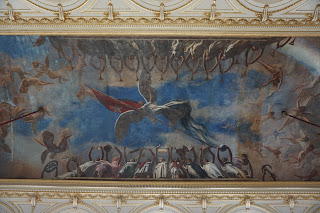 It was designed to look like the
Hall of Mirrors in Versailles, and I suppose it comes close. It was
under renovation when I visited, so I only got to peek in. The
ceiling is painted, and I imagine it is quite grand when everything
is fixed and sunlight is streaming in. Right now it is a vision of
faded grandeur.
It was designed to look like the
Hall of Mirrors in Versailles, and I suppose it comes close. It was
under renovation when I visited, so I only got to peek in. The
ceiling is painted, and I imagine it is quite grand when everything
is fixed and sunlight is streaming in. Right now it is a vision of
faded grandeur.

As you might guess, all of the
information is presented from those on one side of the fight. There
is no presentation from the US. Parts of the storytelling seemed much
more one sided than others.
 In one display they've accused the
American CIA of bringing Dengue Fever to the island, I have no idea
if that is true or not. The Bay of Pigs is presented as a Cuban
victory, and a demonstration of what the Cuban people really wanted.
In one display they've accused the
American CIA of bringing Dengue Fever to the island, I have no idea
if that is true or not. The Bay of Pigs is presented as a Cuban
victory, and a demonstration of what the Cuban people really wanted.

Just before exiting the building you
walk by a cartoon representation of three US presidents and former
(US supported) dictator Batista. Each of them is displayed as a
character, and next to the character is a thank you. Not a nice thank you, the thank yous are all rather snarky.
 Batista's thanks
says 'thank you cretin for helped us to make the revolution.' Ronald
Reagan's says 'thank you cretin for helped us to strengthen the
revolution.' George Bush Sr's says 'thank you cretin for helped us to
consolidate the revolution.' George W. Bush's says 'thank you cretin
for helped us to make socialism irrevocable.' Let's just say these
are viewpoints that will never be presented in the educational system
in the US, no matter how much we like or dislike any of our former
presidents and/or governments.
Batista's thanks
says 'thank you cretin for helped us to make the revolution.' Ronald
Reagan's says 'thank you cretin for helped us to strengthen the
revolution.' George Bush Sr's says 'thank you cretin for helped us to
consolidate the revolution.' George W. Bush's says 'thank you cretin
for helped us to make socialism irrevocable.' Let's just say these
are viewpoints that will never be presented in the educational system
in the US, no matter how much we like or dislike any of our former
presidents and/or governments.


After leaving the museum, I walked
across the street to a church I'd seen, unfortunately it was closed.
This happened in more than half the times I wanted to visit a church.
Too bad.


I walked along the street known as the
prado to parque central, in front of a fancy hotel. Nothing much in
the park except a statue in the middle (forgot to check who it was.)
Between the hotel and the park was a small parkplatz full of the
classic American cars used as taxis. Eye catching, of course.
 Do
people from other countries like those cars as much as Americans do?
Do
people from other countries like those cars as much as Americans do?

I wandered through more of Old Havana,
and eventually stopped for lunch. I wasn't hungry, but it seemed like
a good thing to do. The food wasn't great, or maybe I was just too
hot to care.
I kept walking, over to the front side
of the Capitolio. There is a construction fence in front of much of
the building, you can't get a photo of the whole set of stairs and
building. Too bad. The guidebook mentions construction as well, how
long has it been going on and how much longer will it continue?


I got home and rested for a couple
hours, which felt amazing.
When I walked up to the malecon this
time, I turned left instead of right, as I had the two previous
evenings. This time my walk took me past the back side of the Hotel
Nacional, which is huge. Pretty quickly I got to the memorial to the
victims of the USS Miami.
 I have to admit I was suprised to see
this, because this was an American ship that blew up; 266 American
sailors died in the explosion. The explosion was the official reason
for the US to get involved in the second war of independence,
otherwise known as the Cuban-American-Spanish war. There were people
hanging out on the shadowed side of the memorial, but the sunny side
was still way too hot.
I have to admit I was suprised to see
this, because this was an American ship that blew up; 266 American
sailors died in the explosion. The explosion was the official reason
for the US to get involved in the second war of independence,
otherwise known as the Cuban-American-Spanish war. There were people
hanging out on the shadowed side of the memorial, but the sunny side
was still way too hot.

I kept walking and got to the Plaza
Tribuna Anti-imperialista, right in front of the new US Embassy.
 The
plaza is filled with flagpoles, they once held hundreds of Cuban
flags. These were put in place because when the building was the US
interests building (during the years there were no diplomatic
relations between the countries,) George Bush Sr ordered a running
ticker on the outside of the building to display headlines from
around the world. These sorts of headlines were not news the Cuban
people had access to, and the Cuban government didn't like the
ticker. The flagpoles and flags went up to block the views of all
except those who walked by the building, and I'm guessing very few
did that. Now the flagpoles are empty, but I took a couple photos
anywho.
The
plaza is filled with flagpoles, they once held hundreds of Cuban
flags. These were put in place because when the building was the US
interests building (during the years there were no diplomatic
relations between the countries,) George Bush Sr ordered a running
ticker on the outside of the building to display headlines from
around the world. These sorts of headlines were not news the Cuban
people had access to, and the Cuban government didn't like the
ticker. The flagpoles and flags went up to block the views of all
except those who walked by the building, and I'm guessing very few
did that. Now the flagpoles are empty, but I took a couple photos
anywho.
 Also, the US embassy is an ugly building. Just sayin....


I kept walking toward nothing in
particular. I ended up on the malecon again, looking at a memorial
for Calixto Garcia. I don't know who he is, I should look it up.
From there I turned around, and headed
back into the grid of streets. I found the synagogue, which wasn't big to begin with, as the Jewish
community in Havana (and Cuba in general,) is really small.

On my way to another hotel I got
popcorn, again only 5 CUP, or 20 American cents. Yahoo for cheap
street goodies.

The next morning I walked toward Habana
Viejo again, aiming for a fancy theatre. Since I didn't have
breakfast in my accomodation (she still didn't have fruit, and that
was what I really wanted,) I figured I should eat something.
 I ended
up getting a 'croissant' with ham and cheese from a bakery. So much
for having fruit. While waiting in line I could feel sweat just
rolling down my back, so gross. I'm glad I didn't want a drink there
as well, because I would've had to wait in a second line, and neither
line was moving quickly.
I ended
up getting a 'croissant' with ham and cheese from a bakery. So much
for having fruit. While waiting in line I could feel sweat just
rolling down my back, so gross. I'm glad I didn't want a drink there
as well, because I would've had to wait in a second line, and neither
line was moving quickly.

I got to the fancy theatre and wanted
to take a tour. Go figure I showed up on the one day of the week it
is closed. Argh. I should've done it the day before.

I find it interesting that the
standards for appropriate dress in a religious building vary so much
around the world. In Rome I would've had to cover shoulders and legs.
In Ukraine I would've had to cover my head, and maybe my legs
depending on the church. In Malaysia I had to wear a cape sort of
thing so I was covered from head to toe.

Since the church was free to enter, I
didn't mind paying 1 CUC to climb the bell tower. (The guy reminded
those who were climbing not to ring the bells, of course.) The views
over the city were nice, and the breeze felt fantastic.
I walked by the fort I'd seen the day
before, but it was still closed. Is it ever open? I could see a
guard, but I don't know what his job was, as no one is going to
attack the fort anymore.

Instead, I walked. And walked some
more. At one point I was in a platz and noticed a girl wearing the
biggest dress I'd ever seen. I overheard some other tourists speaking
English, and they said something about it being her quinciniera (sp?)
and this being the traditional photo shoot.
 Very apparently a lot of money
is spent on these photo shoots. All I could see was a HUGE dress, and
a girl with way too much makeup on her face.
Very apparently a lot of money
is spent on these photo shoots. All I could see was a HUGE dress, and
a girl with way too much makeup on her face.

Not too long after that, it started
raining. To get out of the rain, I stepped into a gallery, which had
some paintings I actually liked. But since I don't have a permanent
home, it made no sense to buy any of them.
The rain continued for the next several
hours, sometimes a little lighter, sometimes a complete downpour. I
moved when it wasn't raining so hard, as did plenty of others.
 I was
near a cafe for a while, and quite amused at the flood level of the
streets. I took one of my favourite photos of the trip then, when an
American classic car was plowing through the water.
I was
near a cafe for a while, and quite amused at the flood level of the
streets. I took one of my favourite photos of the trip then, when an
American classic car was plowing through the water.

When the rain lightened up again, I
started walking back in the direction of my accomodation. After
several stops along the way to wait out downpours, I finally made it
back to the neighborhood. There was a cafe with ropa vieja on the
menu, which I wanted to try. It's basically shredded beef, and was
served with rice and beans, and cabbage. A lot saltier than I
expected, but not too bad.
From there I went back to the Hotel
Nacional (it had finally stopped raining completely,) to use up the
rest of the wifi card I'd started the night before. When I logged on,
it said I had 20 minutes left. Almost two hours later it still hadn't
kicked me off! I definitely wasn't complaining. That was exactly the opposite of what I expected to happen, given that everything is so tightly controlled in Cuba.


