I knew as soon as I booked my flights
to South Africa that I would spend some time in Capetown. Every
person I know who has ever been to South Africa said Capetown was a
highlight, a must see city/place. Though Johannesburg is the capital
and has more people, Capetown gets a lot more visitors. I think it
could be easily argued that Capetown has more culture, and has/d a
larger effect on who/what the country of South Africa is today.
My bus was supposed to arrive a bit
after six in the morning, but of course it was late. We arrived
closer to eight in the morning. I'd made a booking through airbnb,
and kept my host aware of where the bus was.
When I arrived, he
picked me up at the bus station and took me to his house. I'm sure I
could've walked it, but since I had my pack, the ride was nice.
I got the tour of the house, then my
host went to work. While we were in the truck he told me about the
neighborhood, as well as a bit about the city as a whole. When we
parked in front of the house I looked up the street and realized
there was a great view of Table Mountain.
I took advantage of decent wifi, and
got caught up on everything as well as charged my phone. Hours later
I walked out of the house, armed with a plan.
I used one of my apps to create a map
of where I wanted to go that day, what I wanted to see. Needless to
say, it did not go as planned. It was going to be a long walk no
matter what, but that's always fine with me. I crossed over a set of
train tracks, and found out that the exit I thought would be there
wasn't available to me. It turned out I didn't work in that
particular area, so I didn't have a badge to go through.
This block
meant I had to walk quite a ways back, to find a way I could walk. I
was annoyed, but there was nothing I could do. When I tried to
explain that I just wanted to walk through everyone thought I was
crazy for walking in the first place.
I turned around and figured out another
way to go. Since I'd had to walk more than my already long plan, I
didn't get to everything I'd hoped to see that day. Oh well. I
figured I would fit everything in over the next few days. On this new
route I walked by a building that had a giant picture of Nelson
Mandela on the windows.
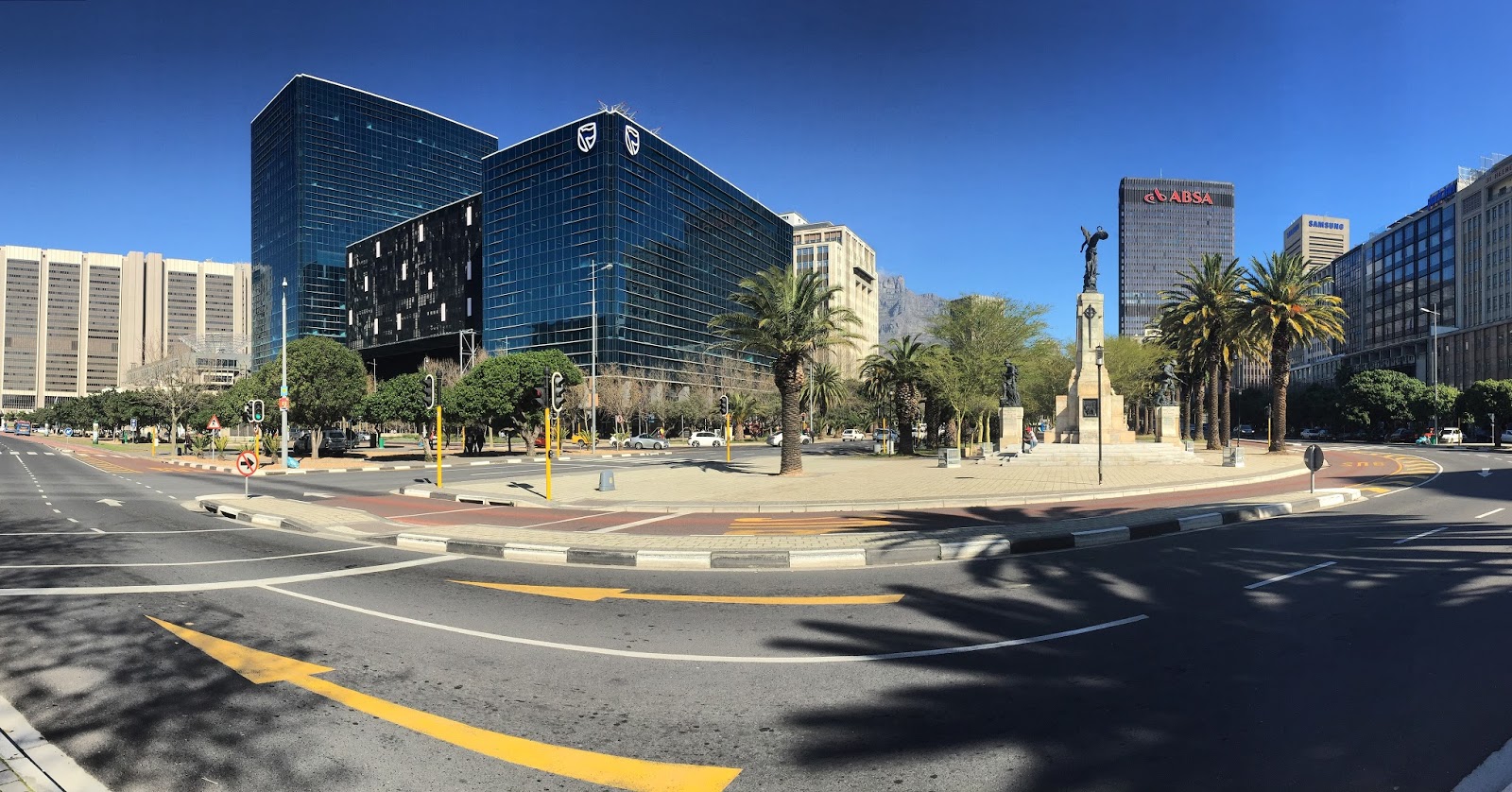
Further along I found a cenotaph,
though I don't remember exactly what it was memorializing. I like
this sort of thing, even though they tend to be similar around a
country. Capetown already looked and felt different to me as opposed
to Johannesburg and Durban. Close to the cenotaph were a couple rows
of green trees. Yes, I know that trees are typically green, but even
the trunks of these trees were green.
My first sight ended up not being at
all what I hoped for. The name is Gold Museum, but it is no longer a
museum about gold. Booo.
It's now a museum about the life of Nelson
Mandela. I was disappointed, but walked through anywho. There were a
few items on display, but it was mostly quotes and pictures and
description of Mandela's life.
I wound my way through the streets to
St George's Church, which was lovely. Nothing extravagant, but I
prefer less splashy. It felt peaceful, and was empty while I was in
there.
Sortof behind the church are the
Company Gardens. Lots of little areas in the gardens, so you feel as
though you're seeing several different gardens.
There were a bunch of
people in the gardens, but with the way it is arranged, it didn't
feel crowded at all. It seemed to be a place people come to enjoy
their lunch break.
I found a decrepit building on the edge
of a parkplatz, upon which was a quote that should be noted around
the world: All are equal before the law.
My next stop was the so called
artillery memorial. The monument itself was backlit at that point, so
I didn't take the photo. There was a small pond in front of the
monument, I had fun watching a couple kids play in the water.
Next to the memorial was the museum of
one person. This museum follows how humankind came to be, from way
back all the way till now. There is a GIANT strand of DNA in front of
the museum, it's impossible to miss. I had to be very patient to get
the photo I wanted, as people kept walking into my frame. Then, just
as people cleared out, a couple ladies decided to do an amateur photo
shoot. Finally they left and I clicked away.
I walked back to Strand Street, a main
street of sorts. I followed the street toward another part of the
city, by the coast. The first part of the walk was uphill, which was
exhausting for some reason or another.
At this point there was
already plenty of traffic, which always makes me a little nervous. I
walked and walked, and finally arrived at the coastal part of
capetown.
I walked to the lighthouse, which
wasn't nearly as exciting as I had hoped. It's painted red and white,
and rather cute.
As I walked along the coast I realized
how much more active people are in capetown than in other cities in
the country. There were heaps of people out for a walk, or a run, or
to do yoga, etc... It was nice to see people out in public.
There
were large green areas, and paths along the coast. This isn't a beach
area, as there are rocks there, not sand. In one of the large green
areas was a huge frame for glasses. Since election day was coming up,
someone had put a sign in the frames reminding people to vote.
I walk a lot more, making my way to an
area of the city called Sea Point. It's filled with shops and
restaurants, one of which is where I had dinner. Sushi, it wasn't
wonderful or awful. To get home I used uber for the first time. Easy,
convenient, and relatively cheap. I wanted to walk, until I realized
it would be over an hour of walking, after dark in a South African
city.
The next morning I followed the same
path I'd walked the day before, which was a cycle and footpath for
part of the way. I made my way all the way to V&A waterfront,
passing a small shipyard along the way. I like seeing things built,
and I could see where some of the workers were living.
In the waterfront area I could see a
clocktower that reminded me a bit of the lighthouse I'd seen the
evening before, it was painted red and white. I found the diamond
museum, and entered. I tried to pay, but they said I could pay after
the tour. To go through the museum one of the employees gives you a
tour, explaining the different exhibits along the way.
The museum
isn't big, but it describes how diamonds are made, how they're mined,
and how they're used. Diamonds are described in terms of shape and
cost and uniquemess. At the end, there is a shop if you want to buy
something.
In a small area of the waterfront are a
couple cannons, they're all that is left of what used to be a fort in
the area.
I ended up having a hot dog for lunch,
as I wasn't in the mood to stop and sit in a cafe/restaurant.
Probably not the healthiest thing I could do, buuuuut.....
My next stop was the medical museum. It
didn't seem well known, it's actually an old hospital (the infectious
disease unit,) located near the modern hospital. After I pushed the
doorbell, I had to wait while they opened the security door for me.
As far as I could tell, I was the only person in the museum at the
time, and no one paid any attention to me.
There were displays of old medical
books, old medical supplies, a mockup of a surgical room, etc...
There were also displays of various diseases that had come to this
area of the world, along with the stories of specific outbreaks.
When I left, I signed the guidebook, which confirmed my thoughts that
this museum doesn't get a lot of visitors.
I walked from there to the Slave Lodge.
This building was originally one of the places where slaves were
brought to be sold after being imported from east African countries.
After the slave trade stopped, it was turned into a set of courts.
Now it is a museum all about the slave trade. There is an area set up
as the interior of a slave ship, which is horrifying. Sooooo many
people were crammed into such a small area. There is a monument
listing some of the known names from one of the major slave trading
companies.
I won't go into details here, but lets
just say that what people have done to other people over history is
absolutely awful. No human is any less than any other human being.
One area of the museum had temporary
displays; one of these was about music. The display had a bunch of cd
jackets, which I loved.
From the Slave Lodge I wanted to go to
the District 6 museum, but it was already closed for the day.
(Museums in this country don't seem to be open very much.) Instead, I
ended up at a place called Charly's Bakery. YUM. Definitely one of
the most brightly coloured bakeries I have ever seen.
After stuffing my face with a brownie
and a cupcake, I walked toward the city fort. Unfortunately, that was
also already closed for the day. Argh. Since I still had some time, I
walked back to the waterfront, getting to see sunset while I was
walking. I got back to V&A waterfront, and took a few night
photos. It's a commercially developed area, there are plenty of
people out there every night for dinner, shopping, and just being
outside.
From there I walked to the neighborhood
known as Bo Kap (sp?) which is known for it's coloured houses. I'd
arranged dinner with a guy I met while traveling through Turkey 4+
years ago.
We'd only met briefly, while each of us was passing time
at a bus station; we had dinner together back then.
Since Terrence lived in Capetown, I
asked him to choose a place, he chose a Malay/Indian restaurant.
Apparently this place had been featured on an episode of Iron Chef
(or another cooking show along those lines,) a couple years ago.
There is a lot of Indian food all over South Africa, but unlike my
memories of India, there is a lot more meat involved in South African
Indian food. Terrence and I ended up closing down the restaurant
because we talked for so long.
The next morning I got up early, even
though it was a holiday. It wasn't a regular national holiday, it was
Election Day. I love the idea of Election Day being a day off for
most people, that way very few people have an excuse for not voting.
My host had made plans to hike on Table Mountain with some friends,
and invited me along. He said it would be a little technical, but I
should be fine. I made sure I had water, snacks, and decent clothing,
and walked out the door.
Mark's friends picked us up, and we
parked under the bottom of the cable car. I think the original plan
had been to hike up, then take the cable car down, but upon arrival
we discovered the cable car was closed for annual maintenance.
That
meant hiking up and hiking down. Adventures are always fun, right?
When I arrived in Capetown one of the
things I knew I wanted to do was hike up Table Mountain. I wanted to
be able to say I made it to the top of such an iconic place.
I was happy Mark had invited me along,
as it meant I didn't have to do any research about how to get to a
trailhead, or what trail to use, or how to get back after hiking. We
met a couple other folks at the parkplatz, then started moving.
Almost as soon as we started, I knew I
was the slowest of the group. I don't get to hike nearly as often as
I'd like, and when I do, I stop quite regularly to take photos and
enjoy whateva views I can see. I didn't mind at all that I was the
slowest, and I hope I wasn't holding anyone back.
We followed a trail called India
Venster. The sign at the trailhead warns that it is a difficult
trail, and some climbing will be needed. Talk about an
understatement. For me, there was real climbing.
I loved every minute of the hike, even
though it was one of the toughest hikes I've ever done. A few times I
had to use my arms to pull myself up and onto a rock, then reach for
the next part of the trail. I felt like a badass, hee hee. The trail
varied constantly, so I never settled into a rhythm. It was an
awesome challenge, and one I would gladly repeat, with someone of
course.
The trail was quite steep in places,
and full of amazing views. I got to see the sun move in the sky, and
I got to see clouds roll in.
At one point we went around a corner and
all of us felt as though we would be blown off the mountain due to
strong winds. Mark showed me that I could see down the ridge, and see
what they called the 12 Apostles. Very picturesque.
We passed a sign that faced the other
way, saying "not an easy way down.' That was even more of an
understatement than the first sign I'd seen that day! There is no way
I would risk going down the trail we came up, as I'm sure I'd fall
all the way down the mountain. I can't imagine many people would hike down that trail, but I'm sure there are a few.
When we got to the top we found out the
cafe was closed, along with the cable car. This was a disappointment,
but thankfully all of us were prepared just in case. As we were on
top it got really cloudy, and the wind kept up. We were all rather
cold, and didn't linger as long as we would've in the sun.
Another reason I'm glad I was with
other people: they knew other trails on the mountain, and knew how to
hike down. We went down a trail called Platteklip Gorge, which was
basically a giant, neverending, very irregular staircase. Since I
have little to no natural grace or coordination, I had to watch every
step I took.
It maybe sounds crazy, but my mind was exhausted as we
went down, so I had a hard time staying upright. As with any descent,
my quads were totally wrecked by the time I got to the bottom,
waaaaay behind everyone else.
I was so far behind that I got totally
separated. Thank goodness I had my phone, as I called Mark and
figured out where to find everyone else. They picked me up, and we
drove back closer to Mark's neighborhood. We stopped at a cafe, just
because we could. I loved my sandwich, though it wasn't anything
special. It's funny how simple food tastes so amazing after hard
physical effort. If I lived here I'd like to think I'd do heaps of hikes like this one.
After going home, I took a nap, and
rested my legs. Around 1600, I left the house and started walking
back toward V&A waterfront again. I went shopping in an outdoor
store, finding a pair of pants that I sorely needed. Yay. From there
I walked to Long Street, since I'd seen an Indian restaurant there a
couple days earlier and wanted to try it out. Unfortunately, it was
closed. Fortunately, there was another Indian place across the
street. The new place looked cheaper, and more basic. I was happy to
try it out :) I ordered a thali, which ended up being way too much
food, but I was happy to eat as much as I could.
The next day after I came back from
Simonstown I went back to the same restaurant and had a vegetable curry
and roti. Yum. This is the life!
The following morning I was up early
again, and walked back to the waterfront. I'd bought tickets online
for a tour of Robben Island, thankfully there were still a few
available during my visit in Capetown. They were booked out several
days in advance.
I
went through a security check before boarding the boat, going through
a metal detector, and having to show my ticket and form of
identification.
The boat that took us to Robben Island had three levels, I managed to
get to the second level. On the way to the island I got to stand on
the second level, in the back. This meant I got the view of the city
and mountain as we drove away. I can see why there are so many photos
of that view.
The boat pulled up to the dock at the island, and everyone boarded
one of several buses. On each bus there was a guide up front with a
microphone, who started by introducing themselves.
After the introduction, the us pulled out and started driving around
the island. Almost immediately our guide noticed a penguin waddling
down the road, he said they come to the island occasionally. Needless
to say, this made me very happy.
As the guide said, Robben Island is most known as where Nelson
Mandela spent most of his 27 years of imprisonment, but that is far
from the entire history of the island.
We saw part of the village in which island employees live, which
includes a church. We saw what used to be the school, (kids now
commute to capetown every day for school,) and a small coffee shop.
There aren't a lot of people who live on the island, but they're
necessary, when you think about it.
We also saw one of the quarries where prisoners did hard labor. We
saw a little bit of the WW2 history of the island, where an artillery
battery was located. Those guns could shoot a looong way, the island
is a very strategic point. I wish we could've gotten off the bus at that point.
Finally we came to the entrance of the prison. We all piled off the
bus, and our bus was greeted by a new guide.
All of the guides for the prison portion of this tour are former
prisoners. When they describe parts of life and parts of the prison,
they're describing parts of their prior life. It gets intense at
times.
Our guide showed us different areas of the prison, including the cell
where Mandela lived. We saw group housing, the recreation years, the
so called Mandela's Garden, etc... I was fascinated, and horrified.
The only thing I wish I'd been able to hear was an idea of what daily
life was for the prisoners.
We
walked back to the dock, and boarded the boat for the return
trip. This time I had to sit inside, and it made me really
really seasick. The waves weren't that bad, but I react to such
things rather dramatically. The ride back to Capetown felt a lot
longer than the ride out because I was miserable. Ugh.
We
got off the boat back at the port, and I immediately noticed a group
of seals laying out on the docks. Very cute. Ugly at the same time.
From
the waterfront I walked to the castle of good hope, also called the
city fort. It was under renovation in a lot of areas, but it was
open. I paid my entry fee and went in to see what I could see.
It
turned out there wasn't a lot of anything of interest for me, argh. I
saw a room with art on display, a couple goats in the courtyard, and
a few ducks in the courtyard. I most enjoyed climbing up to the roof,
though I don't think that area was open to the public. When I see a
door that isn't specifically closed and blocked off, I like to see
what is behind the door. I found a random stairwell and followed it
all the way up to the roof. Great views of Table Mountain.
After
the castle/fortress I walked to the District 6 Museum. It's called
District 6 because that was the name of the area that had a huge flip
flop in the days of apartheid. The neighborhood was mostly black
originally, but in a location whites wanted.
So the government told
the blacks to get out, and tore everything down so whites could
redevelop the area. The result of tearing everything down was in a
huge loss of culture. Families lost housing, neighborhoods lost
sports areas, hair salons, etc... Reading the information and seeing
the photos was heartbreaking. It's a small museum, filled to the
brim.
I
stopped in Charly's Bakery after leaving the museum, but didn't buy
anything. I have no idea why, but nothing appealed to me. I don't
know how such a thing is possible! I should point out everything looked good, but nothing screamed "eat me!"
After
the museum I walked toward city hall, going around the entire
building. It turns out that the first public speech given by Mandela
after his release from prison was right in front of city hall. There
is a huge platz there, usually filled with some vendors, and cars.
I
walked home, stopping at a supermarket for dinner food. Along the way
I kept looking at Table Mountain, which was wearing a hat of clouds.
After a few days in the city I could understand why there are so many
photos of Table Mountain. It's appearance changes all the time,
depending on time of day and the weather.
The
next morning I got up in time to do laundry, then Terrence picked me
up for a day trip. Read about that in another post.
When
I arrived back home I took the time to start packing my stuff, and
figure out arrangements for the next morning.
The
next morning I was up in time to catch an uber taxi to the airport,
which ended up being cheaper than I expected. Yay! I paid for my
ticket (they let me book it on the phone, then pay cash when I
checked in, I wish that happened more often!) and made my way through
the airport.


 I went through the whites only entrance, which was definitely a lot easier (wider and less crowded,) than the blacks and coloureds entrance.


 On the day in 1976, schoolchildren had decided to go on strike, and the protest was to start on a street corner near the school. A student by the name of Hector Pieterson was shot by the police, the photo of another student carrying Pieterson body is one of those iconic photos known by people around the world.

 They process it, take a commission, then print a check. When you go to cash the check you have to pay taxes (on your refunded taxes!!) and a fee to get your money. Argh. I spent what I did get back on postcards, which always make me happy.