Showing posts with label WWII memorial. Show all posts

05 July 2020

russia: moscow oblast: mozhaisk


Mozhaisk is another random town I visited in Moscow Oblast, not long after it became permissable for me to do so. I was just happy to be able to see a new place, and wore a mask the entire time I was on the train. It is not listed in my Russia guidebook, so I must've heard about it through social media.

Mozhaisk is about 110 kilometers west of Moscow, with a population of just over 30,000. The documented history goes back to 1231, when it was part of the Chernihiv region. (This region is part of what is now Ukraine.) Later it was part of the Smolensk region, followed by the Moscow region. At some point in history, Mozhaisk was also part of Lithuania, showing how big that empire was at various points. 

What I get from reading this history is that the location was important, but the city itself was never strong enough to be independent.

In 1812 the Battle of Borodino took place not far from Mozhaisk, just 12 kilometers away. I hadn't realized how close the two towns are until I saw a few signs in Mozhaisk pointing in the direction of Borodino. I'm guessing some people come to both of them on one day on a tour.

During WW2 the Wehrmacht took control of Mozhaisk in October 1941, the Red Army took it back in 1942.

Mozhaisk is now a relatively small town. It isn't well known, and definitely isn't on the 'must see' list for anyone visiting Russia. That being said, its a cute town, with history worth seeing.

It is easy to get to Mozhaisk, all I had to do was take an elektrichka, which took two hours. The train station isn't in a particularly convenient location, but it was still walkable distance, at least in my head.

I started by walking toward the stela that marks Mozhaisk as a city of military glory. It looked just like the majority of such monuments I've seen. 

There was nice landscaping around the monument, and as I looked over to buildings nearby, I saw huge murals showing war scenes on the sides of the buildings. Mozhaisk clearly knows its own history as a location where lots of fighting has taken place.

I took photos and kept going. Next up was the first of two Lenins I wanted to see. The first was a full size statue on a pedestal, painted silver. He stood in front of a government building of some sort. Nothing special, but I always want to see Lenin statues.

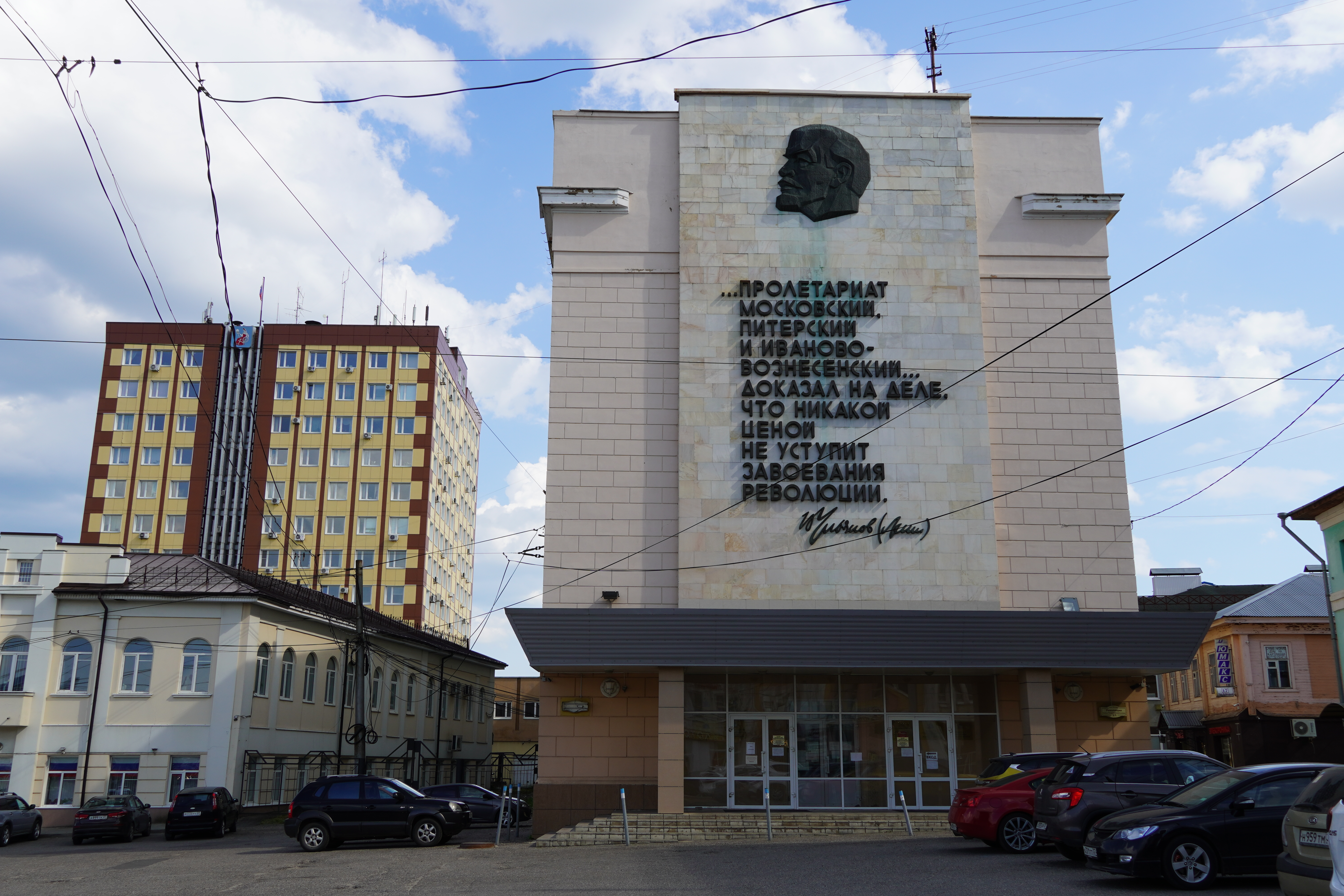
My second intended sight was also a Lenen, though this one was just a large profile of his head, on the side of a grocery store. (It always surprises me where I find Lenin.) The walk to get to the profile took a while, (as it was basically on the other side of town,) but the weather was nice, and it gave me some great views over the surrounding area.

After seeing the Lenin profile, I walked back toward the city center, heading in the general direction of the main sight in town, the kremlin. For reasons I don't know, the kremlin in Mozhaisk is called the Detinets, but I'll probably refer to it as the kremlin throughout this entire post.

One of the views on the way to and from the Lenin profile was of the kremlin, which sits on the edge of a small hill. Absolutely lovely. If there had been trails to walk around the hill, I would've been happy to walk all the trails. 

The kremlin itself is several centuries newer than the town, though still plenty old. The first cathedral in the kremlin was made of stone, and built in the early 14th century. As I got close to the kremlin, I realized it was still very photogenic, but also really small. Standing at the entrance gate I could see the entire territory, I think it was just two churches, and a model of what the kremlin used to look like.

As I was there during the height of summer, the flowers were in full bloom, the grass was green, etc... The sky was blue, so every photo I took was full of colour. At least from the outside. The inside of the churches wasn't nearly as eye catching. It didn't take me long to visit the churches and wander over the entire territory, it really is a small area.

From there I went back to the main street in town and followed it north. This part of my visit took me past a WW2 monument, which had the usual combination of a wreath, an eternal flame, plaques with names, and dates. I took a few minutes to honour those who gave everything for their country (whether they wanted to or not,) then kept walking.

A little bit later I saw a sign telling me to turn left to get to a monastery. This monastery is the second main sight of Mozhaisk. An official tour of the city probably includes the kremlin and the monastery, then moves out of the city.

Luzhetsky Monastery is the short name for a relatively small place. The full name is Nativity of the Theotokos and St.Therapont Luzhetsky Monastery. I wonder if anyone ever calls it the full name, because its certainly a mouthful. I didn't even try saying the name in Russian, not even in my head. 

Luzhetsky Monastery was founded in 1408, by a man named Therapont Belozersk. He created the monastery based on the commands of Prince Andrey of Mozhaisk, who never let him leave. Belozersk died in the monastery in 1426; he was later canonized by the Russian Orthodox Church.

Luzhetsky monastery is surrounded by white walls with a few towers. The main cathedral, which was built and rebuilt several times, has five domes, and sits in the middle of the territory.

As I got closer and closer to the walls and entry gate, dark clouds started rolling through the sky, really really fast. Since there are a couple open fields near the monastery, the view of those clouds over the monastery was quite striking. This kind of a sky is my second favourite. (My favourite is a blue sky, with a few white clouds; yes, I'm very basic at times.)

There was no fee to enter the monastery, and since the main church is the only thing open to see, it didn't take me long to visit. Like about half the churches in Russia, the outside of the church was more eye catching (probably because of the crazy clouds,) than the interior. (The other half are the other way around. It seems rare that a church looks amazing both inside and outside.)

Not too far from this monastery was a house museum, that of artist S.V. Gerasimov. I ended up on a mini tour of the museum, which was not my intention. The docent clearly wanted to practice her English, and she seemed nice, so I let it happen. 

The museum was mostly paintings of Gerasimov, though there were also displays of the work of his family members and his students. All in all it was nice.

My last attempt at a sight was another church. Unfortunately, the entrance gates to the territory of this church weren't open, darnit. Oh well.

By that point it had started to rain. Thank goodness the rain wasn't too heavy, but it made the walk allllll the way back to the train station really humid and rather unpleasant. Because of the rain I wanted to take public transport, but when I looked at my options, it was only going to be five minutes faster, and was still going to cover half the distance with walking, so I opted to walk the entire way.

My arrival at the train station were nearly perfectly timed, I only had to wait 20 minutes for the next train back to Moscow. Yay!

I doubt I'll return to Mozhaisk, I think I saw everything on the list of sights.

28 June 2020

russia: ivanovo


I don't really why I decided to visit Ivanovo, or how it ended up on my list of places to go in Russia. I'm sure that at least part of it is because I was able to do it as a day trip from Moscow. Since hotels and cafes still weren't open properly, nor are many stores and such, I wouldn't have been able to stay overnight even if I had wanted to, so I had to choose a close town or city to visit.

Ivanovo is about 250 kilometers/160 miles from Moscow, with a population of a little over 400,000. The population is slowly shrinking, this started at the beginning of the century. It was first known as Ivanovo-Voznesensk, the latter part of the name was dropped in 1932.


Ivanovo is almost 500 years old, it was first mentioned in historical documents in 1561. The modern city boundaries were created when the flax processing village of Ivanovo merged with Voznesensy Posad in 1871. This merger mixed an agricultural village with an industrial town, which became the textile capital of Russia. In fact, Ivanovo competed with Lodz to be the textile manufacturing capital of Europe for quite a while. Traditionally, it is still the textile capital of Russia, though the actual industry has mostly left the city. 


Ivanovo has interesting WW2 history, as the city played host to a group of French pilots; the training they had created the so-called Normandy-Niemen legendary air squadron. Wikipedia tells me they were given decent housing (whateva that means,) and training on Yak 1 fighter planes.

Getting to Ivanovo was easy, though it wasn't fast. I rode the 'fast' elektrichka, called a lastochka. Even so, it was still nearly four hours. It was the first time I've worn a mask for that long, not particularly fun. That being said, if wearing a mask when I'm indoors is the price to pay for being able to travel a little right now, I'm all for it.


Upon arrival I discovered the entire train station was under renovation, I wasn't able to go inside at all. It looked as if the city had moved the ticket desk into a side building for the time being, I wonder how long it will take before the train station is open again.

As I exited into the platz/parkplatz in front of the station I noticed that the apartment buildings on either side of the station had something in common: they both had mosaic murals covering the entire side. Awesome.


On the other side of the platz was a monument, it looked like a giant female head with wings, if that makes sense. From what I can find online, the monument was put up to honour the 70th anniversary of the October Revolution.

I started my exploration of the city by heading for the first of three Lenin statues I hoped to see during the day. I was surprised when I found him, as the statue was clearly old, and had seen little to no maintenance in quite a while. 


Paint layers cracking and chipping off, wildgrass growing really tall around the whole thing. Usually Lenin statues are given at least basic care and cleaning.

I'd hoped to see a monastery next, but when I got to the gates I found a sign saying it was closed for quarantine. I imagine monasteries around the country will keep their gates closed a bit longer while they can, to help protect their typically more elderly populations.


Not too far from this monastery was a former cinema, abandoned as far as I could tell. It had a "Soviet" look about it, I love this kind of stuff. Weeks later while looking at something online I found out the cinema closed about 10 years ago, and has just been sitting there.

I kept going down the street and found a war memorial, complete with wreaths, an eternal flame, plaques with names, and a statue on top of a really big pedestal. This one was specifically dedicated to the heroes of the front.


After seeing the monument I headed toward the next spot I'd marked on my map, an apartment building. I know that sounds rather lame, but it was designed in the shape of a half circle, so I was keen to see what that looked like from the 'inside' of the circle. Interesting, but not photogenic.

Next up was the 'main' Lenin of the city. This time he was located in the middle of Leninplatz, and there were actually other people around the statue. I'm used to seeing Lenins in mostly empty areas. This time I watched kids taking a break from practicing tricks on their scooters.


The next 'sight' I saw wasn't mentioned anywhere, I just found it eye catching. It looked like a watchtower on top of an office building? It looked abandoned, so who knows what it used to be.

Before arriving in town I'd searched my name on Yandex maps, and found a place named after me in Ivanovo. Eva shaping class, whateva that is. After seeing 'my' class, I wanted to visit three different museums, but they didn't look open to me. They might've been, but if so, it wasn't obvious. 


The descriptions of the museums were interesting, so maybe I'll go back to Ivanovo at another time, when things are a bit more 'normal.'

Not too far from the museums was the third Lenin of the city. As I got closer to the statue I could see that he was behind a barrier, which was guarded by a soldier. It looked as if the building behind the statue was a military/official building. I knew I wouldn't be able to stand right next to the statue, but I took the chance to ask the soldier if I could take a picture of just Lenin. He said yes, so I made the photo and moved on. This is Russia, anything military makes me a bit nervous.


Since the museums weren't open, I went to a park. It was nice to be in the shade for a while, as the heat was getting to me by that point. At one end of the park was a ferris wheel, though it wasn't running. In the middle of the park was a monument to Frunze, and near the other side of the park was a 'tunnel' of hearts with letters spelling out LOVE at one end.

Not too far from this park I found the 0km marker that exists in a surprising number of Russian cities. They're not always marked on maps, so you don't always see them, but they do exist. This one was in front of the main post office of Ivanovo.


From there I stopped at a supermarket on my way to Revolution Square, which had another large, Soviet realism styled monument. Nothing unique. I turned a corner and headed toward one of the last sights I wanted to see. A church, one that was actually open, yay!

It was surrounded by white walls, and the onion domes were painted blue. Simple decoration outside, plenty of good frescoes on the walls and ceiling inside. The iconostasis up front was gold, there were a few people praying to the various icons around the 'sanctuary.'


My last sight in Ivanovo was another park, called art square. It was pretty small, and had no shade. I was interested because there were a few sculptures to see; a dog, a musician, and a really big guitar which was covered in flowers.

As soon as I'd made all the photos I wanted to, I walked back to the train station, an easy walk. My timing worked out really well, I didn't have to wait long for my train back to Moscow.

I'd definitely return to Ivanovo, probably at another time of year. I'd like to see the museums, and I wonder what the city looks like under a cover of snow.

19 June 2020

russia: tver again


The first place I decided to visit when it became possible was Tver. Though I'd visited the city with my ladies last year, there were parts of the city we didn't see. Plus, it is close to Moscow, so I was able to do an easy day trip.

A day trip meant I didn't have to worry about accomodation, or food. I brought my snack bag with plenty of food, knowing I'd be able to find a bench somewhere in the city to sit on while eating. Cafes weren't yet open, I knew I wouldn't be able to get food that way.


I wore a mask the entire time I was on the train, which was just under 2 hours. The train wasn't as busy as normal, but it was more than half full. I'd say about half the people were wearing masks, and half of those were wearing them properly.

I arrived in Tver around 10am, it was hot. I started sweating almost as soon as I stepped outside the train station, but oh well. I'd planned out what I wanted to see in the city ahead of time, and marked all the spots on a map, I didn't want to waste time.


My first stop was a statue of Lenin, this one was not in the city center. To get there I walked a couple back roads, crossed a pedestrian bridge over the tracks of another train station, and passed some eye catching buildings. I'm a sucker for wooden houses, particularly those that have been kept up well, as they often have gorgeous flowers all around, 
and intricately carved window decorations. So pretty, and so quaint.

This particular Lenin was at the back side of a small park, and behind him was red stone, I think it was supposed to represent a red flag. 


These statues of Lenin always fascinate me, because I'm usually the only one around. It's rarely difficult to take a photo without anyone else in the frame.

After taking my photos with and of Lenin, I sat on one of the benches in the park to eat. Being in the shade felt soooo good, I already knew I'd have major heat exhaustion by the end of the day.

From there I walked back toward the part of the city most people visit when they come to Tver. Along the way I stopped at what used to be a big factory complex. 


There were signs with the history of the complex, but they were entirely in Russian, and I was hot. I should've taken pictures, to translate later, but I didn't.

I think some of the buildings are now used as apartment buildings, a couple are just plain abandoned, and others are maybe still factories? I'm not sure. I found an area with playground equipment, but it was slowly being taken back by nature.


After the factory area, I walked to a monastery. The name of the main church in the monastery was the Resurrection Cathedral, but I can't find the name of the monastery, argh. I was able to see a small chapel, and a church, both of which were outside the walls. Unfortunately, the monastery gates were still closed, so I wasn't able to see any churches or buildings inside the walls. The map I was using had me going through the monastery grounds, so I had to find another way around, which ended up being quite a bit longer than expected.


Normally I wouldn't have minded the extra walking, but like I wrote earlier, it was hot, and I was feeling it. When I got around to the other side of the monastery, there was a sign on the gates that basically said it was still closed for quarantine. From what I could tell, only people who belong inside the walls were going to be allowed in.

My next stop was an obelisk honouring the victory of the Allies in WW2. A very typical Soviet victory monument. There was another small church not too far behind the obelisk, also closed at the time. 


At this point, that wasn't much of a surprise. Many of the people I've seen in Russian churches are older, so they're more at risk for getting sick with Covid 19. As much as I want to travel normally, I also want to keep people safe if I can, and that sometimes means not seeing something.

Not long after that I got to one of the major bridges over the river, just by an art museum we visited in a previous trip to Tver. The bridge had walkways one both sides for pedestrians, there were plenty of people walking on the bridge. 


On the other side of the bridge I noticed something I hadn't seen during the first visit to Tver, a beach! There were quite a few people hanging out on the beach, enjoying the weather.

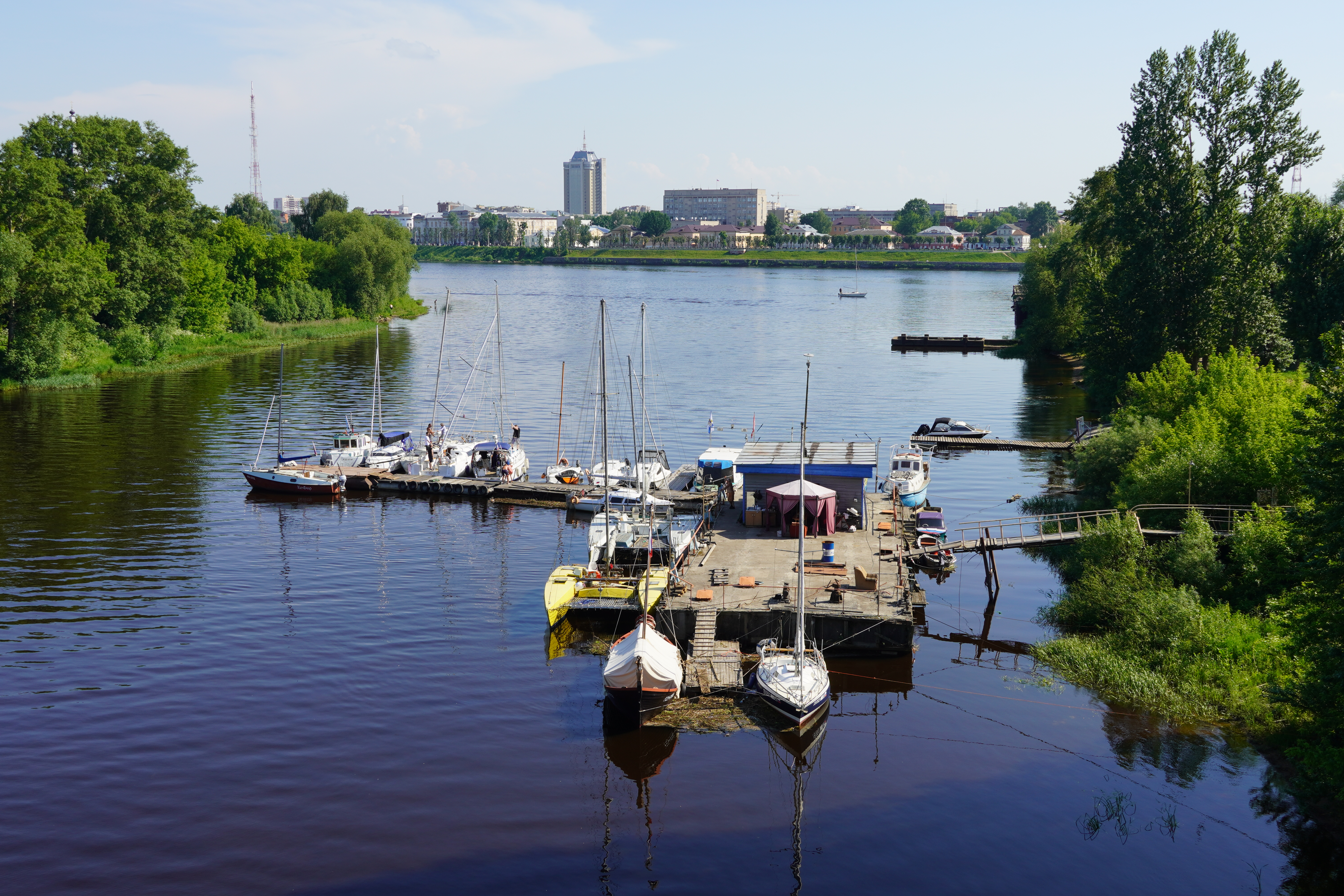
I turned onto another street, and before long ended up on another bridge. Walking over that one gave me a view of a pretty little marina, with a few boats moored. I wonder how many people in Tver have boats, and how often they use them. For that matter, how long is it considered boating weather? Where do the boats go when the river freezes?


Not long after crossing that bridge, I realized I needed to turn around and go back a bit. The road I was on at the moment wasn't going to connect with the part of the city I needed to get to. I know I've said it before in this post, but extra walking wasn't sounding as good as normal because of the heat and sun.

Continuing to walk, I passed the biggest/main Lenin statue in town. I also passed a stela that showed Tver is considered a city of military glory.


Eventually I got to my last sight of the trip: a mosque. Though Russia is generally known as an Orthodox Christian country, there are plenty of other faiths represented in the country. This mosque wasn't huge, but it was easily recognizable as a mosque. What I immediately noticed was that it was right next to a Catholic church. I love that kind of juxtaposition. I wonder if the congregations have any sort of relationship with each other.

From there I found the closest bus stop, and caught a bus back to the train station. Tver doesn't have a big train station, and not a lot of traffic, so they don't let you onto the platform you want until just a few minutes before the train arrives. 


Of course this means people gather right next to the barriers, (not many of them wearing masks,) waiting for the moment those barriers are removed.

The train back to Moscow went exactly as scheduled, which is exactly what I expected :)

Tver is a great city as a quick trip from Moscow, but now that I've seen it in winter weather and summer weather, I don't think I need to go back.

27 January 2020

russia: moscow oblast: lobnya


After nearly a month straight of traveling I decided to spend a weekend in Moscow. I chose to spend Saturday doing very very little. My fitbit tells me I took less than 500 steps, if that tells you anything.
Sunday I had another lay in, then took my sweet time getting moving. Eventually I got out the door, and hopped on the metro. In the last year Moscow has opened two new metro lines. They go further into the suburbs than previous lines, which is awesome.


A suburb called Lobnya had been on my list of places to go, since I saw that it had a specific spot in the history of Moscow and WW2. According to many historians Lobnya is the place closest to Moscow that the Germans occupied during the war. This was while the town was known as Krasnaya Polyana; I don't know why the name was changed, or when it happened.
Wikipedia tells me the town was founded in 1902, and was granted town status in 1961. There are currently 75,000 residents.


It only took me an hour or so to get to Lobnya, and cost less than $1USD. I'll repeat it again and again, I love public transport :)
I didn't see everything in town that I wanted to see, but knowing how easy it is to get there, I know I can go back to see the rest.
I started by walking down ulitsa Lenina (Lenin Street,) which is the main street in town. The weather hadn't improved since last weekend, it could be considered even worse. It had snowed a couple times during the week, but not a lot. After each snow it had warmed up to a degree or two above freezing, meaning the snow melted and ended up as slush and mud. Yuck.


Lenin Street wasn't that exciting, it didn't feel like much of anything. Many of the apartment buildings were painted various shades of yellow, which I find horrid. One of the buildings had a mural of the fighting in WW2 on the side, which was.... interesting.
I didn't walk through the city park, mostly because I didn't want to deal with the slush and mud I knew would be everywhere. I'll definitely explore the park the next time I go back.


Eventually I got to a bus stop where I caught the next marshrutka to a specific war memorial called the Moscow defensive line. It ended up being really small, and hardly noticeable. The stop was just across the street from the memorial, it was actually the end of the line for several bus/marshrutka lines.
The memorial consisted of a billboard, a couple 'snowflakes' of metal pieces (I don't know the right word to name or describe them) and a plaque.
From there I walked to another memorial, in Krasnopolyana Square. It was a 'basic' WW2 memorial, with a big statue and plaques listing the names of those from the area who died. 


This square was more of a small park, there were no benches or anything to encourage people to hang out for a while.
I walked to a supermarket I'd seen earlier, to get something to drink, and snacks. From there it was an easy marshrutka ride back to the train station, then another train back to central Moscow.
I'll be back, as I know there are a couple memorials I missed, and I want to see the city park when it looks better :)


Even though Lobnya isn't terribly well known, I realized there were some spots in the city that I hadn't yet seen, so I went back for another half day visit a few weeks after my first visit. The weather was somewhat better in that it wasn't raining or snowing, and the ground was mostly dry, but the sky didn't look any better.
I went out there the same way I did during my first visit, using one of the new commuter metro lines Moscow has opened this year. Easy and quick.


Since Lobnya is pretty small, I barely had to pull out my phone to check where I was going. My first stop was in the city park, a small platz with a pair of war memorials. The one that was particularly memorable was dedicated to the kids who suffered during the war. They didn't have a say in anything that was happening, and had no opportunity to speak up.
It was easy to walk out the other side of the park, and as I did so, I noticed a cute 'animal' statue just outside the fence: a pair of pandas. I'm not sure why the city chose to have them there, as they're not local to the area. Hmmm.


My next sight was another set of war memorials, the walk to get there was a lot longer. Along the way I saw a memorial I didn't expect: a helicopter. It didn't have a sign that I could see, but it was placed right along the main road, not too far from colourful apartment buildings. I've seen a lot of tanks as war memorials, at least the helicopter was a little different.
When I got to the place I wanted to see, I realized the set of war memorials were spread out on each of the three sides of the intersection (it was a T-junction.) One was a mural painted on one side of a small building. Another was a tank, and the third was an obelisk. None of them were particularly memorable or unique.


After that I felt like I wanted to see something that was not a war memorial, so I headed to the one church I'd noticed on the map. The Church of the Holy Face in Kiowa was not any different from other churches I'd seen previously.
I wanted to see the interior, but when I opened the door I heard and saw a service taking place, so I only stood at the back of the room for a few minutes, then stepped back out. While I was in there someone else left, so I wasn't doing anything disruptive. I liked what I could see, as there were nice frescoes all over, and the chandelier was bright.
From there it was an easy walk back to the train station, with a quick stop at a pond on the way. Last year Claire and Angela used to tease me about wanting to see anything marked in blue (water,) on a map, I guess I still do that :)


08 April 2019

russia: ufa

We put Ufa on our travel calendar after seeing it listed as a destination on a departures board at an airport. We thought the name was quirky, and hey, why not?
Ufa is the capital of the Republic of Bashkortostan, (formerly called Bashkiriya,) which is the most populous republic in Russia. I'm not sure what the difference is between a republic and a state in this country, it has something to do with governance, and who has authority, I think. Wikipedia says it is a state with no sovereignty, though that doesn't help me figure it out. 
Bashkortostan is officially bilingual, speaking Bashkir and Russian. Nearly every sign we saw was in both languages, with occasional signs adding English as well. Bashkir is a Turkic language, so it doesn't sound at all like Russian. The modern Bashkir alphabet similar to Cyrillic, though there are some dfferent characters.
Ufa has just over a million official inhabitants, and has been around in one form or another since the 5th century. It was a medieval city, before the arrival of the Russians, though the official founding date is 1574 when Ivan the Terrible ordered a fort built there. 
That fort was later destroyed, and the city itself doesn't feel like it has much history. In general it feels like a young city, despite what historians say.
Ufa has an economy very dependent on industry and natural resources. Wikipedia mentions oil refining, mechanical engineering, and other fuel and engineering companies. It isn't a beautiful city persay, but things do look nice.
Ufa is a two hour flight from Moscow, and is two time zones ahead of Moscow. This meant our two hour flight that took off from Moscow at 2030 on Friday arrived after midnight in Ufa. 
Since we're cheap, we spent the rest of the night at the airport. Ufa International Airport isn't big, but we were able to find some chairs without armrests on which to try and doze for a while.
After taking photos with city and airport signs in the sun, the next morning we took the bus into the city center, the ride was about 25 kilometers and cost less than a dollar. According to the signs at the bus stop, it runs every 20 minutes or so, which is really convenient. During the ride we spotted several groups of people doing city cleanup type of work. 
Raking dead twigs, chopping up piles of snow that still remain, picking up rubbish, etc... It was impressive to see so many people taking care of their city.
We hopped off somewhere along Lenin Street.
We started our city tour by seeing a statue of Lenin in the middle of a small park. The man was sitting, and there was an obelisk behind him. We kept going along the street, coming to a statue of Fyodor Shalyapin. (There is some debate as to how his name is spelled in English, this is the option I'm using, just because.) 
He was a Russian opera singer in the late 19th and early 20th centuries. After some searching online, we found information telling us that the statue was in Ufa because he spent some of his childhood there. The statue is located on the side of a concert hall now named after him, at which he performed. Across the street was another theatre, no one can accuse Ufa of not having culture.
From there we found a city sign for Ufa. We loved it because it was written in Bashkir, so it looks like three circles. Each circle is crossed by a line, horizontal or vertical. 
We also found a city sign with the name written in Russian, so we took photos with both.
Claire and Angela were both exhausted so we stepped into a cafe thinking we'd have a drink to wake up. It didn't work out that way, but after being inside for about an hour we decided to walk toward our booked accomodation.
We got in contact with the potential landlord who didn't seem thrilled to hear from us. It was a challenge for me to understand what he was saying, he didn't slow down even when I specifically asked him to do so. 
It turned out the apartment we'd booked wasn't available, so he sent us an address nowhere close. According to the link he sent, it was also more expensive than what we booked. To make a long story short, we stayed somewhere else.
After checking in, we relaxed for a bit and figured out a plan for the rest of the day.
Our next sight was a giant memorial to the heroes of the October revolution. I'm used to big Soviet memorials, but this one was bigger than normal. There were kids running around this one, totally unaware that anyone else was around.
From there we walked toward a sight listed as permanently closed on Google maps. Google maps was wrong, we were able to go in the Lenin House Museum. It turned out to be the house in which his wife and mother in law lived in while they were in exile in Ufa. Lenin visited twice during 1900, which apparently qualified it for being a museum now. The entry fee was low, we really liked our visit.
Close to the house museum was another city sign, this one also written in Bashkir. It sat on one side of a platz, there wasn't anyone else around. 
I guess everyone else in the city had already had their photo taken with this sign.
We kept going, intending to walk up Kirov street; we got distracted by a small souvenir/press shop. In the shop we found magnets and postcards, something we look for during all of our trips. After looking at all the postcards we decided to head to a place called Congress Hall, which is actually a conference center with modern architecture.
It was easy to get there by bus, and didn't take long. We liked the building, and there is a small park right next to the building that was filled with people. 
At the end of the park is a monument to Salavat (Salawat) Yulaev, a hero of the Bashkir people. He lived during the 18th century, and was involved politically in a number of events. The monument has him sitting on a horse, which is perched on a hill overlooking the entire region.
At that point we needed a proper meal, so we found a restaurant. Dinner started out well, with a good menu, good prices, etc... Angela and I liked our food, but not all of Claire's food arrived. A manager came out to apologize to Claire a good 10-15 minutes after we'd finished eating, which was a bit late. 
I didn't understand enough of what she was saying to understand the reason, I just understood that Claire's food wasn't coming. Sigh.
After a stop at a grocery store, we walked home, and crashed quickly. Since Claire and Angela hadn't slept much at all at the airport they were more tired than I was, plus they were also fighting colds, making them even more tired.
The next morning we packed up and checked out at 1100, stepping out into a beautiful day.
We ended up stepping into a bakery a couple blocks away, even though we probably should've avoided a place with sugar loaded food. The lady inside was amazed by us, I'm guessing she doesn't see many foreigners. We enjoyed the donuts and other goodies we found there.
Our first sight of the day was a church. It was blue, and looked quite new. It turns out the Cathedral of the Nativity of the Blessed Virgin Mary is 100 years old. Apparently the church has received good care over the years, we never would've known it was more than a decade or two old. 
The frescoes were bright, the chandelier and iconostasis gold. We were inside with plenty of people, I loved the atmosphere.
After we left the church we took off some layers, since it was quite warm. Sun and more than 10C is tshirt weather :) We walked up Kirov Street all the way to Mustaya Karima Square. There is a statue of him in the middle of the square, it was surrounded by families out to enjoy the sun. Mustai Karim was a Soviet poet, writer, and playwright in the 20th century. Over his lifetime he won important prizes like the Lenin Prize, and the State Prize of the USSR.
His monument stands in the middle of the square, the Trade Union building stands on one edge of the square. From the Trade Union building we walked down Karl Marx street. Along the way we stepped into another park, because we liked the gate. Inside the park we found a war memorial that wasn't working. There was no fire in the eternal flame, and park of the obelisk was being fixed.
More walking brought us to the train station. It was ugly, a dark gold colour. From there we caught a trolleybus that took us 12km to Park Pobedy, or Victory Park. 
It was quite a long ride, and only cost 20 rubles!! We got off the bus near a memorial with a sad woman statue. I don't know what it was for, but it looked new.
Next door to the sad woman memorial was Lyalya Tulpan Mosque. It had two minarets, I found information saying it could hold 1000 worshippers. We were happy to go in, the women's sectioon was actually a big balcony on the next floor up. Quiet, fairthful, and beautiful. Everything I love about a house of faith.
Next to the mosque was Park Pobedy. 
We skipped the war museum, as we didn't want to take the time, and didn't figure it would be all that different from other war/military museums we've seen around the country. All around the park were tanks, on which kids climbed everywhere.
At the back of the park was another eternal flame memorial, this one also being repaired. There was fire in this one, though the obelisk was completely covered by scaffolding. We wandered through the rest of the park, but didn't love all the people everywhere. (The downside of good weather.)
We left the park and got back on the trolleybus, going all the way to the end of the route then coming back into the city. This time we got off the bus at another Lenin statue, it was really big. Like everywhere else in the city it was covered in people out enjoying the weather. We took our team photo and left.
We found a different restaurant for dinner, and had a fabulous experience. Great food, good prices, good service, etc... After dinner we took a taxi to the airport where it was easy to check in, and everything else went smoothly. Our flight landed in Moscow a few minutes early, something always appreciated.
We loved Ufa, but feel as though we saw everything. I don't think I have a reason to return, but who knows?